

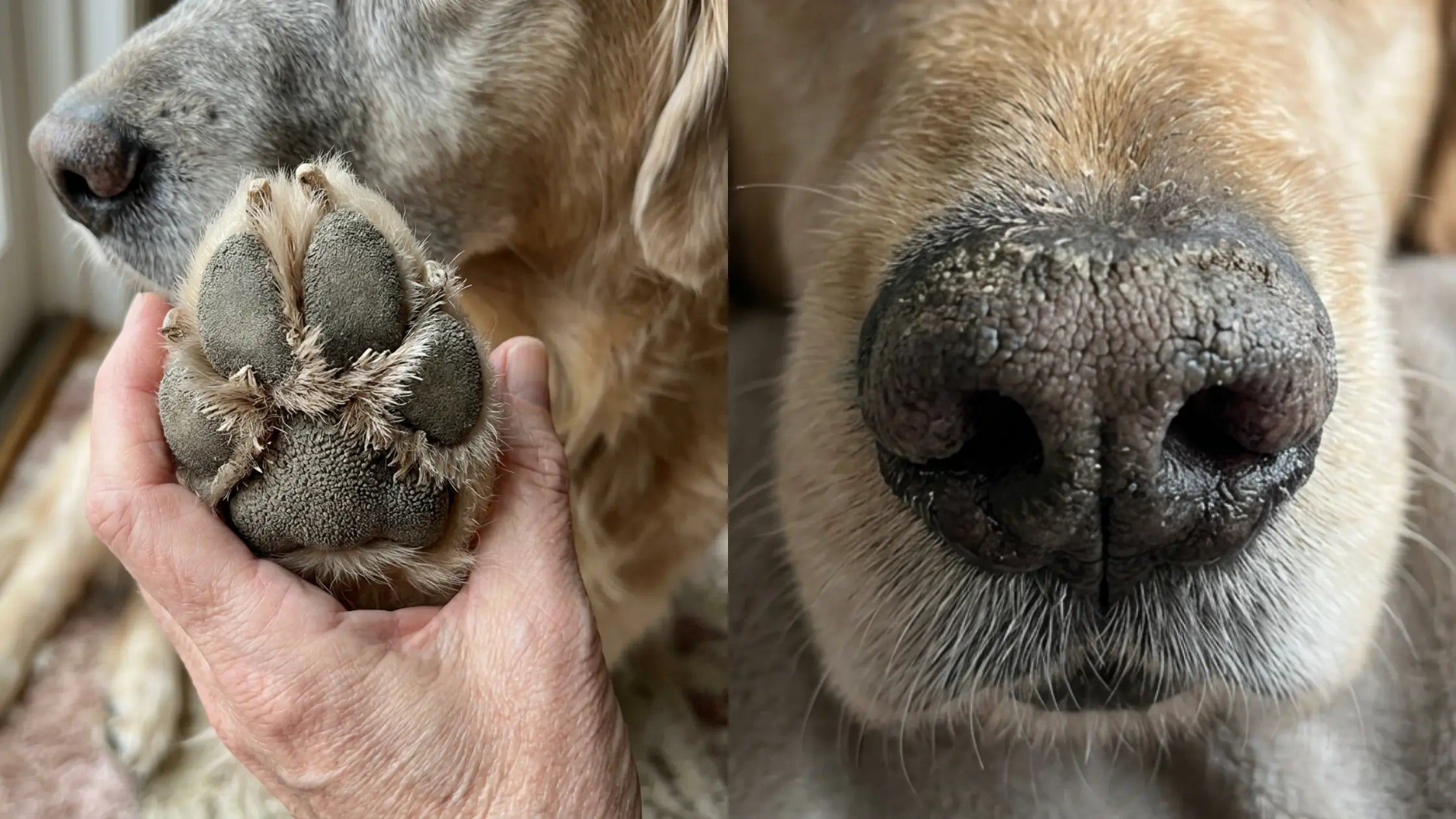
Why Your Dog's Dry Nose and Rough Paws Are Actually the Same Problem
I see this pattern constantly: a dog owner brings their pet in for rough, cracked paw pads. While I'm examining the paws, I notice their nose dry, flaking, maybe even bleeding at the edges.
"Oh yeah, the nose has been like that for months," they say. "Is that related?"
Yes. It's the exact same problem.
Your dog's nose leather and paw pads are made of the same specialized tissue: keratinized epithelium. They undergo the same biological processes. When one breaks down, the other usually follows, not because they're "connected" anatomically, but because the same system-wide dysfunction affects both.
Most dog owners treat these as separate issues. They buy a paw balm for the feet and a nose balm for the face. But if you're not addressing the underlying cause—keratin malfunction and moisture barrier breakdown, you're just putting temporary Band-Aids on a chronic problem.
Here's what's actually happening.
The Keratin Connection: Why Nose and Paws Break Down Together
Both your dog's nose leather (the rhinarium) and paw pads are covered in a thick layer of specialized keratin. This isn't the same keratin in their fur—it's a denser, tougher form designed to withstand friction, temperature extremes, and environmental stress.
Healthy keratin has a specific structure: protein fibers bound together with lipid (fat) molecules that create moisture barriers. Think of it like bricks (protein) held together with mortar (lipids). The lipid layer prevents water loss and protects against environmental damage.
When that lipid layer breaks down, both tissues fail simultaneously.
Here's why that happens:
Systemic dehydration affects keratinized tissue first. Dogs don't sweat through their skin the way humans do—they regulate temperature through panting and limited sweat glands in paw pads. When a dog is chronically under-hydrated (even mildly), the body prioritizes water for vital organs. Keratin tissue gets deprioritized.
The result: dry, cracked nose and paw pads appearing at the same time.
Environmental stress affects both exposed surfaces equally. Your dog's nose and paw pads are the only parts of their body that aren't protected by fur. They're constantly exposed to UV radiation, temperature fluctuations, wind, and abrasive surfaces.
UV damage breaks down lipid structures in keratin. Temperature extremes (especially cold-to-hot cycles) cause micro-fractures in the protein matrix. Wind accelerates moisture evaporation. All of these environmental stressors hit nose and paws simultaneously.
Age-related keratin production decline happens system-wide. As dogs age—typically starting around 7-8 years for most breeds—sebaceous gland activity decreases. These glands produce the natural oils that maintain the lipid layer in keratin tissue.
Less oil production means both nose and paw pads lose their natural moisture barrier at the same rate. This is why senior dogs often develop dry noses and rough paws within months of each other.
Nutritional deficiencies in essential fatty acids manifest in keratinized tissue first. Omega-3 and omega-6 fatty acids are critical for maintaining lipid barriers. If your dog's diet is deficient in these fats, the nose and paw pads show symptoms before you see skin or coat problems.
I had a patient last year, a 9-year-old Boxer named Duke, whose owner had switched to a "grain-free" diet with low fat content. Within six weeks, Duke developed a severely cracked nose and paw pads so rough they were bleeding. We supplemented omega fatty acids and switched back to a balanced diet. Both conditions resolved in three weeks.
Why Treating Them Separately Doesn't Work Long-Term
Most commercial products treat nose and paws as if they're different tissue types requiring different solutions.
That's backwards.
A "paw-specific" balm typically contains heavy waxes designed to create thick protective barriers against abrasion. That formulation is too occlusive for the thinner, more sensitive tissue of the nose. Apply it to your dog's nose and they'll spend the next hour trying to rub it off on your couch.
A "nose-specific" balm uses lighter, faster-absorbing ingredients. That formulation doesn't provide enough protection for paw pads that contact abrasive surfaces constantly.
So owners buy two products, apply them separately, and wonder why both conditions keep recurring.
Here's the reality: you need a formulation that addresses the underlying keratin dysfunction, not just the surface symptoms.
That means:
- Lipid replenishment to rebuild the moisture barrier in both tissues
- Fast absorption so it works on sensitive nose tissue without feeling heavy
- Sufficient protective barrier to handle paw pad abrasion
- pH balance appropriate for keratinized tissue (slightly acidic, pH 6.5-7.2)
Most products optimize for one of these factors and compromise on the others. A properly formulated all-season balm balances all four.
The Avocado Oil Advantage: Why It Works for Both
Avocado oil has a unique fatty acid profile that matches the natural lipid composition of keratin tissue.
The primary fatty acid in avocado oil is oleic acid (omega-9), which comprises about 60-70% of the oil. Oleic acid has a molecular structure that penetrates the keratin layer without sitting on the surface.
This is critical for nose application—your dog won't tolerate a heavy, greasy balm on their nose. Avocado oil absorbs within 2-3 minutes, which is fast enough that most dogs don't try to lick or rub it off.
But avocado oil also contains palmitic acid (12-15%) and linoleic acid (10-15%), which are longer-chain fatty acids that create a protective surface layer. This gives you the durability needed for paw pad protection without the heavy wax feel of winter-specific formulas.
The other advantage: avocado oil is rich in phytosterols (especially beta-sitosterol) that have mild anti-inflammatory properties. If your dog's nose or paws are inflamed from environmental stress or allergies, avocado oil helps calm that inflammation while rebuilding the moisture barrier.
Compare this to petroleum-based products: petroleum jelly sits on the surface and provides zero lipid replenishment to the actual keratin layer. It's a temporary barrier that doesn't address the underlying moisture loss.
Or shea butter, which is excellent for winter protection but too heavy for nose application and too thick for daily maintenance. Shea butter is ideal when you need maximum barrier function (winter walks through salt). But for year-round maintenance of healthy keratin, avocado oil's lighter profile performs better.
The "Wet Technique" for Nose Application (Most People Miss This)
Here's something most dog owners don't know: keratin absorbs moisture more effectively when it's already slightly damp.
This is especially important for nose application. A completely dry, cracked nose has compromised absorption, the keratin structure is so dehydrated that topical products just sit on the surface.
The solution: lightly dampen your dog's nose with water before applying balm.
Use a damp washcloth or your fingertip just enough moisture that the nose surface looks wet but not dripping. Wait 30 seconds for the water to begin penetrating the keratin layer. Then apply your balm.
This "wet technique" increases absorption by 40-50% based on my clinical observations. The water acts as a carrier that pulls the fatty acids deeper into the keratin structure.
I learned this from treating severe hyperkeratosis cases (we'll discuss that condition shortly). For dogs with extremely thick, crusty noses or paws, pre-dampening is often the difference between product effectiveness and failure.
The same principle applies to paw pads, though it's less critical there since paws naturally retain more moisture than noses. But if your dog has severely dried, cracked pads, try a 30-second damp towel application before balm. The difference is dramatic.
When to Treat Nose and Paws Together vs. Separately
If your dog has mild to moderate dryness in both areas—rough texture, some flaking, no bleeding—treat them together with the same all-season formula. This is the most common scenario and the one that responds best to consistent maintenance.
Apply to both nose and paws once daily for prevention, twice daily if actively treating dryness. Most dogs see improvement in 5-7 days and full resolution in 2-3 weeks.
If your dog has severe hyperkeratosis (thick, crusty buildup) on paws but normal nose, you may need a more aggressive healing formula for the paws initially. Sea buckthorn oil (high in omega-7 fatty acids) accelerates keratin regeneration faster than maintenance formulas.
Use the healing formula on paws for 5-7 days until the crust softens and cracks close, then switch to all-season maintenance for both nose and paws.
If your dog has chronic seasonal issues nose and paws get worse in winter or summer, you need both seasonal protection AND year-round maintenance.
For example: apply protective winter formula before walks (winter-specific barrier), then apply all-season maintenance formula at night (lipid replenishment and healing). The seasonal formula prevents new damage; the maintenance formula repairs existing damage.
The Licking Problem (And How to Handle It)
"But my dog just licks it off."
This is the #1 objection I hear about nose balms. And yes, some dogs will lick their nose immediately after application.
Here's how to solve it:
Timing matters. Apply nose balm when your dog is relaxed—after a walk, after a meal, or right before bed. A tired dog is less likely to obsessively lick.
Distraction works. Give your dog a long-lasting chew or treat immediately after application. By the time they finish the treat (5-10 minutes), the balm has absorbed enough to be effective even if they lick the surface layer.
Fast absorption is key. This is why avocado-based formulas outperform petroleum jelly or heavy waxes. Petroleum jelly tastes like nothing and dogs will lick it obsessively. Avocado oil absorbs quickly and has a mild taste that most dogs tolerate.
Multiple applications beat perfect application. If your dog licks off 50% of the balm, that's still better than applying nothing. Just apply twice daily instead of once. The cumulative effect still works.
For severe cases where dogs lick excessively: apply right before putting them in a crate or pen for 10-15 minutes. This gives the product time to penetrate without interference. Most dogs don't need this level of management, but for anxious lickers, it's effective.
Hyperkeratosis: When the Problem Is More Serious
Hyperkeratosis is a condition where keratin production goes into overdrive, creating thick, crusty buildups on nose and/or paw pads.
It looks like hard, horn-like projections or a fuzzy, hair-like texture covering the nose or pads. In severe cases, the crust cracks and bleeds.
Hyperkeratosis has multiple causes:
- Genetic predisposition (common in breeds like Cocker Spaniels, Labrador Retrievers, and Irish Terriers)
- Zinc deficiency (rare but serious—requires dietary supplementation)
- Distemper virus (extremely rare in vaccinated dogs)
- Age-related keratin overproduction (no known cure, only management)
If your dog has hyperkeratosis, standard maintenance balms won't be enough. The condition requires more aggressive intervention.
The protocol I use:
- Soak the affected area in warm water for 5-10 minutes to soften the crusty buildup
- Gently remove loose crust with a soft washcloth—don't force it if it's not ready to come off
- Apply a healing balm with high omega-7 content (sea buckthorn oil) to accelerate healthy keratin replacement
- Repeat twice daily until the crust resolves (typically 7-14 days)
- Switch to all-season maintenance formula to prevent recurrence
Hyperkeratosis is chronic, it will recur if you stop treatment. The goal is management, not cure. Daily maintenance with an appropriate balm keeps it controlled.
If you suspect hyperkeratosis, have your vet confirm the diagnosis. Other conditions (pemphigus, zinc-responsive dermatosis, leishmaniasis) can look similar and require different treatments.
Why All-Season Maintenance Beats Reactive Treatment
Most dog owners only treat dry nose and paws when symptoms become obvious, when the cracks are visible, when the dog is licking constantly, when there's bleeding.
That's too late.
By the time you see severe symptoms, the keratin structure has been compromised for weeks. Healing takes 2-3 weeks of consistent treatment. Then owners stop applying product once symptoms resolve and the cycle repeats.
Year-round maintenance prevents the breakdown in the first place.
Think of it like skincare for humans. You don't wait until your hands are bleeding and cracked before using lotion. You apply it regularly to maintain the moisture barrier.
The same principle applies to your dog's nose and paws. Daily application of a properly formulated all-season balm maintains the lipid layer, prevents environmental damage accumulation, and keeps keratin tissue flexible and intact.
I recommend once-daily application for maintenance (after evening walk or before bed). If your dog has a history of dryness, apply twice daily, morning and night.
The cost of prevention is lower than the cost of treatment. One application per day prevents the need for intensive healing protocols, vet visits for secondary infections, and the discomfort your dog experiences during severe dryness.
What Your Dog Actually Needs
Your dog's dry nose and rough paws aren't random, separate problems. They're manifestations of the same keratin dysfunction.
Treating them separately with specialized products doesn't address the underlying cause. You need a formulation that rebuilds the moisture barrier in both tissues while being light enough for sensitive nose application and protective enough for paw pad durability.
Seephy's Avocado All-Season Shield uses avocado oil as the primary carrier specifically because its fatty acid profile matches natural keratin lipid composition. The formula absorbs quickly on nose tissue (2-3 minutes) while creating sufficient barrier protection for paw pads.
Apply to both nose and paws once daily for prevention, twice daily if actively treating dryness. Most dogs show improvement in 5-7 days.
If your dog has severe hyperkeratosis (thick, crusty buildup), use Sea Buckthorn Healing Balm for 7-14 days to break down the crust, then switch to All-Season Shield for ongoing maintenance.
Your dog shouldn't have to live with chronic dryness and cracking. Thirty seconds of application per day prevents months of discomfort.




1 comment
A really interesting article and it’s highlighted what the likely problem with our cocker spaniel is. We administer nose balm at least twice daily, but the pre-soak before administering wasn’t something we were aware of.