Written by Dr. Marcus Chen, DVM | Jun 02, 2026
"Why does my dog keep licking his paws?"
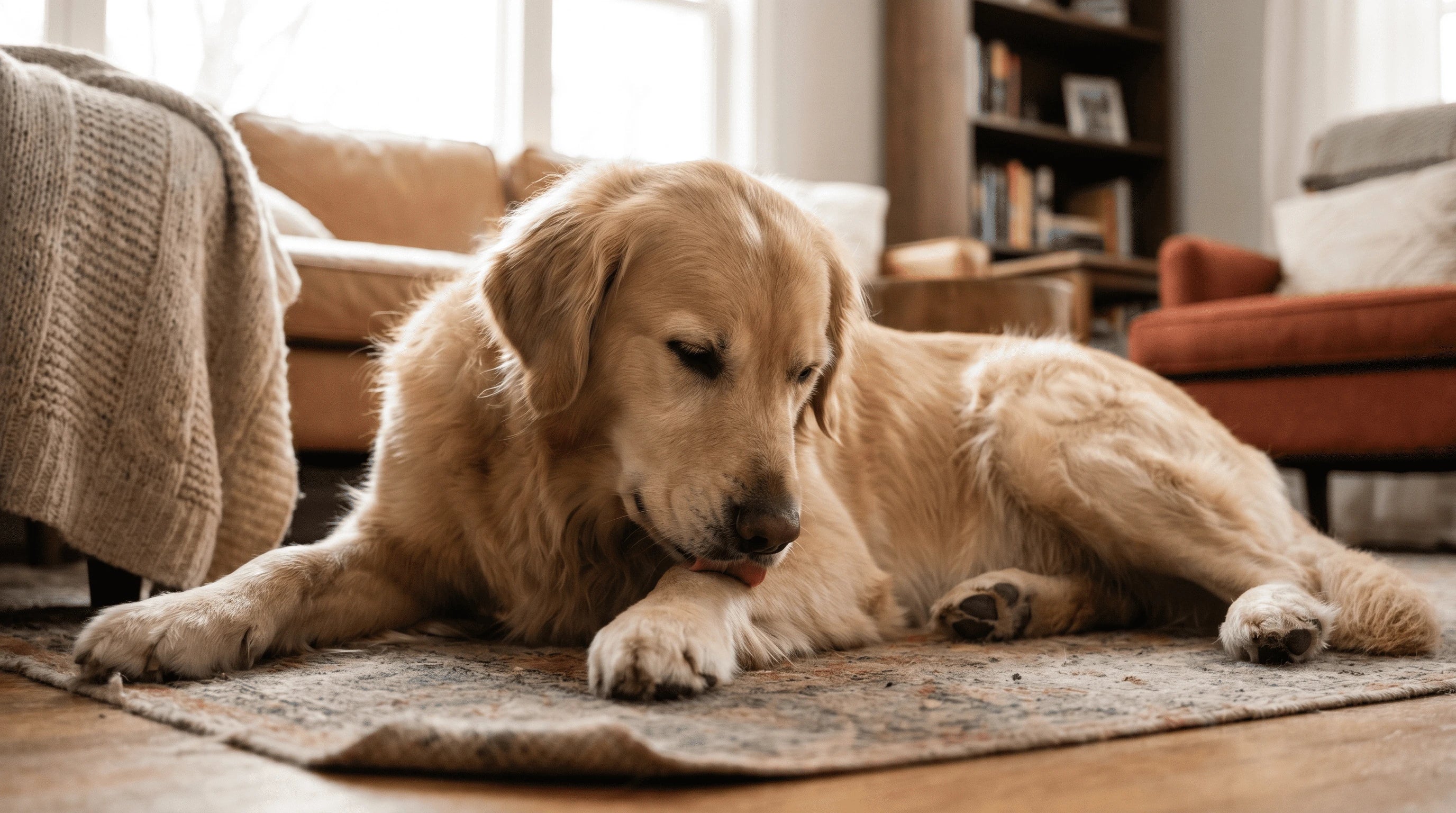
I get this question almost daily. It's one of the most common complaints in small animal practice and one of the most frequently misdiagnosed.
Owners typically try one solution: a topical product, a bitter spray, a behavioral correction. None of these address the actual cause in most cases, which is why the licking continues despite the owner's best efforts.
Here's what most owners don't realize: paw licking has three fundamentally different causes, and each requires a completely different approach:
1. Allergies (the most common cause)
2. Injury or skin condition (often hidden between toes)
3. Anxiety or compulsive behavior (least common but most misunderstood)
Treating the wrong cause makes the problem worse. A dog with environmental allergies who gets behavioral training will still lick. A dog with a foxtail embedded between toes who gets antihistamines will continue licking until the foreign object is removed.
Diagnosis comes first. Treatment second.
Here's how to tell the three causes apart, when to see a vet, and what actually works for each.
Why Dogs Lick Their Paws (Normal vs Excessive)
Before diagnosing a problem, understand what's normal.
Normal paw licking includes:
- Brief grooming sessions (a few minutes, then the dog moves on)
- After walks or outdoor activity (cleaning debris)
- Self-soothing during rest (occasional, not constant)
- Cleaning a specific spot that resolves quickly
Excessive licking that signals a problem:
- Licking the same paw repeatedly for extended periods
- Licking that wakes the dog at night
- Licking that creates visible damage, wet fur, red skin, hair loss
- Licking accompanied by chewing or biting
- Licking that worsens at specific times (after meals, certain seasons, when left alone)
- Licking continues despite topical treatments
The threshold: If you find yourself thinking "my dog is licking too much," you're probably right. Owners are excellent observers of their dogs' normal behavior, deviation from normal usually signals something underlying.
Cause #1: Allergies (The Most Common Driver)
In my practice, allergies account for about 55-60% of excessive paw licking cases.
Why paws specifically? Paws are constantly contacting allergens, grass, pollen, dust mites, household chemicals, food residue on floors. The skin between toes is thin and highly absorbent, so allergens penetrate easily.
Three types of allergies cause paw licking:
1. Environmental allergies (atopic dermatitis)
The most common allergy type. Triggered by pollen, grass, dust mites, mold, household products.
Telltale signs:
- Seasonal pattern (worse in spring/fall for pollen-sensitive dogs)
- Both front paws affected (sometimes all four)
- Skin between toes appears red or pink
- Licking worsens after walks on grass
- Often accompanies other symptoms: ear infections, face rubbing, belly itching
2. Food allergies
Less common than environmental but often missed because owners don't connect food to paws.
Telltale signs:
- Year-round symptoms (not seasonal)
- Often includes digestive symptoms (loose stool, gas, vomiting)
- Ear infections are common companion symptom
- Symptoms persist despite environmental treatments
3. Contact allergies
Allergic reaction to something the paws physically touch—lawn chemicals, certain fabrics, cleaning products on floors.
Telltale signs:
- Sudden onset after exposure to something new (new yard treatment, new flooring)
- Localized to the contact area (often paws and belly if dog lies on the surface)
- Resolves when exposure removes
What allergic paw licking looks like physically:
Examine the paws carefully, pull the toes apart and look at the skin between them:
- Pink or red skin (inflammation)
- Skin appears moist or shiny (chronic licking)
- Brownish staining on light-colored fur (saliva discoloration, a classic allergy sign)
- Yeast smell ("corn chip" or musty odor between toes)
- Possible secondary infections in severe cases (visible pus, sores)
The brownish saliva staining is one of the most reliable allergy indicators. It's caused by porphyrin compounds in saliva oxidizing on exposure to air, chronic licking creates the rust-colored discoloration.
Why allergic licking is so persistent:
Licking releases temporary relief through endorphins and physical sensation—but it doesn't address the underlying inflammation. So the dog feels brief comfort, the inflammation returns, the licking resumes.
It becomes a cycle:
- Allergen contact → inflammation → itching
- Licking → temporary endorphin relief
- Saliva on inflamed skin → bacterial/yeast overgrowth
- Secondary infection → MORE itching
- More licking → more damage
This is why topical anti-itch products often fail. They mask the symptom temporarily but don't break the cycle.
Treatment approach for allergic paw licking:
Step 1: Identify and reduce allergen exposure
- Wipe paws after walks with damp cloth or paw-safe wipes
- Avoid grass-treated lawns if pollen-sensitive
- Use unscented detergents on bedding
- HEPA air filtration can help indoor allergens
Step 2: Maintain skin barrier integrity
- pH-buffered paw balm supports the skin's natural barrier
- Daily application to between toes (most-affected area)
- Avoid alkaline soaps when washing paws (disrupts skin pH)
Step 3: Veterinary intervention for moderate-to-severe cases
- Antihistamines (effective in some dogs)
- Immunotherapy (allergy shots—most effective long-term solution)
- Cytopoint or Apoquel (newer targeted treatments)
- Topical corticosteroids for acute flares
For mild seasonal cases, paw-wiping plus skin barrier support often controls symptoms. For moderate-to-severe allergies, veterinary intervention is necessary, home treatment alone won't resolve it.
Cause #2: Injury or Skin Condition (Often Hidden)
Injuries account for about 25-30% of excessive paw licking cases in my practice.
The challenge: Many paw injuries are invisible to casual inspection. The dog feels them and licks, the owner can't see them and assumes it's behavioral.
Common hidden causes:
1. Foreign objects between toes
- Thorns, splinters, glass shards
- Foxtails (grass seeds, especially dangerous, can migrate)
- Small pebbles lodged in webbing
- Burrs and seed pods
2. Cracked or split paw pads
- Hairline cracks invisible without spreading toes
- Often along pad edges
- Worse after exercise on hard surfaces
3. Yeast or bacterial infection between toes
- Often secondary to allergies but can occur alone
- Characteristic odor (musty, "corn chip" smell)
- Brownish discharge between toes
- Visible redness and moisture
4. Interdigital cysts (interdigital furunculosis)
- Painful nodules between toes
- Often appear as red bumps
- Common in certain breeds (English bulldogs, Labradors, Pit bulls)
- Caused by deep follicular infection
5. Burns (thermal or chemical)
- Hot pavement burns in summer
- Salt/ice melt damage in winter
- Pool chlorine stripping
6. Insect stings or bites
- Spider bites (often hidden under hair)
- Tick bites (slow-onset irritation)
- Mosquito bites in summer
7. Nail problems
- Cracked or split nails
- Ingrown nails (especially in dewclaws)
- Infections at the nail bed
Telltale signs licking is injury-related (vs allergy):
✓ Single paw affected (allergies usually affect both fronts)
✓ Sudden onset (allergies often build gradually)
✓ Dog flinches when paw is touched (specific localized pain)
✓ Visible swelling, redness, or wound on close inspection
✓ Licking concentrated on one specific spot (not whole paw)
✓ No seasonal pattern (consistent regardless of conditions)
✓ Distinct odor (suggests yeast or bacterial infection)
How to inspect for hidden injuries:
Follow the 7-step inspection process used for limping evaluation:
- Observe before touching (which paw, which spot is targeted?)
- Visual overall check (compare to other paws)
- Spread the toes carefully—this is where most foreign objects hide
- Examine each pad individually
- Check every nail (including dewclaws)
- Feel for heat or swelling (signs of infection)
- Check above the paw (rule out non-paw causes)
Related: The complete 7-step paw inspection technique with detailed instructions
Use a magnifying glass for small objects. Foxtails and grass seeds can be 1-2mm nearly invisible without magnification.
Treatment approach for injury-related licking:
For foreign objects:
- Remove with clean tweezers if accessible
- Clean wound with mild antiseptic
- Monitor for infection 24-48 hours
- See vet if object is embedded, you can't remove it, or if it's a foxtail (these can migrate dangerously)
For cracks or wounds:
- Clean with mild antiseptic
- Apply healing balm with omega-7 fatty acids (accelerates regeneration 40-60% vs passive healing)
- Restrict activity 5-7 days
- Reapply balm twice daily until healed
Complete healing protocol: The 3-phase system for cracked paw pads
For suspected yeast/bacterial infections:
- Veterinary diagnosis required (we culture or use cytology to identify the specific organism)
- Topical or oral antifungals for yeast infections
- Antibiotics for bacterial infections
- Underlying cause investigation (often allergies need treatment too)
For interdigital cysts:
- Veterinary evaluation (treatment varies by severity)
- Often requires antibiotics, sometimes surgical drainage
- Long-term management for chronic recurrence
Cause #3: Anxiety or Compulsive Behavior
Anxiety and compulsive licking account for about 10-15% of excessive paw licking cases, less common than owners often assume.
The misdiagnosis problem: Many dogs with allergies or hidden injuries get labeled "anxious lickers" because:
- Owners can't see the underlying cause
- Licking persists despite topical treatments
- Behavioral interventions seem necessary
True anxiety-driven licking is real, but less common than physical causes—and even when anxiety contributes, there's often an underlying physical trigger that started the behavior.
Signs licking is genuinely anxiety-related:
✓ Clear behavioral triggers (when left alone, during storms, with new people)
✓ Licking is part of broader anxiety patterns (pacing, panting, destructive behavior)
✓ No physical findings on thorough inspection
✓ No allergic indicators (no saliva staining, no seasonal pattern)
✓ Improves with anxiety management (medication, behavioral training)
✓ History of anxiety or fearful behavior in other contexts
Types of anxiety-driven paw licking:
1. Separation anxiety
- Licking only when alone
- Returns to normal when owner is present
- May include other separation behaviors (destruction, vocalizing)
2. Generalized anxiety
- Licking during stressful events (storms, fireworks, vet visits)
- Self-soothing behavior in response to fear
- Returns to baseline when stress resolves
3. Compulsive disorder (canine acral lick dermatitis)
- More serious condition, obsessive-compulsive behavior
- Specific spot (usually one front paw, often the wrist)
- Creates a thickened, raised lesion ("lick granuloma")
- Persists regardless of environment
- Requires veterinary behavioral intervention
True compulsive licking is rare but distinctive. The granuloma it creates a thickened, sometimes hairless area on the lower leg or paw, is unmistakable.
The chicken-and-egg problem:
Even when anxiety contributes, there's often a physical starting point:
- Dog has an itchy paw (allergy or injury)
- Dog licks for relief
- Licking releases endorphins (temporary comfort)
- The behavior becomes self-rewarding
- Original cause may resolve, but behavior continues
- Now we have both a physical AND behavioral problem
This is why physical causes must be ruled out first, even if anxiety appears to be the trigger.
Treatment approach for anxiety-driven licking:
Step 1: Confirm no physical cause
- Thorough paw inspection
- Veterinary examination if uncertain
- Trial allergy management if any indicators present
Step 2: Address the underlying anxiety
- Environmental enrichment (more exercise, mental stimulation)
- Anxiety management training (counterconditioning, desensitization)
- Pheromone diffusers (Adaptil) for some dogs
- Behavioral medications for moderate-to-severe cases (consult vet)
Step 3: Interrupt the licking habit
- Bitter sprays (some success but doesn't address cause)
- Cone or recovery suit during behavioral training
- Distraction techniques (interactive toys, treat puzzles)
Step 4: Veterinary behaviorist for severe cases
- True compulsive disorder requires specialist intervention
- Medication often necessary
- Long-term behavior modification protocols
The Diagnostic Framework: Three Questions to Ask
Here's the framework I use in practice to identify which cause is driving the licking:
QUESTION 1: How many paws are affected?
Both front paws (or all four): → Likely allergies
One specific paw: → Likely injury or localized infection
Always the same paw, specific spot: → Possible compulsive behavior (lick granuloma)
QUESTION 2: What's the pattern?
Seasonal pattern (spring, fall): → Environmental allergies
Year-round consistent: → Food allergies or chronic infection
Specific triggers (storms, alone time): → Anxiety
Sudden onset after a walk: → Foreign object or acute injury
Worse after meals: → Food allergy likely
QUESTION 3: What does the paw look like?
Red, pink, brown-stained fur, possibly between toes: → Allergies
Visible cut, swelling, or foreign object: → Injury
Musty smell, brown discharge: → Yeast infection
Raised, thickened area on lower leg: → Lick granuloma (compulsive)
No visible findings, behavioral triggers present: → Anxiety
Combining the answers gives a strong indication of the cause, but a definitive diagnosis often requires veterinary examination, especially for moderate to severe cases.
When to See a Vet
For mild cases, home assessment and basic care may be sufficient. For these situations, see a veterinarian:
🚨 Licking creates visible wounds, raw skin, or hair loss
🚨 You can't identify the cause after thorough inspection
🚨 Symptoms persist despite home interventions (2-3 weeks)
🚨 Yeast or bacterial infection signs (odor, discharge, severe redness)
🚨 Foxtail or other migrating foreign object suspected
🚨 Lick granuloma forming (thickened, raised area)
🚨 Severe allergic symptoms affecting quality of life
🚨 Anxiety severe enough to interfere with normal life
Allergies in particular benefit from professional management—immunotherapy, targeted medications, and proper allergen identification often dramatically improve outcomes that home care alone can't achieve.
Common Questions About Dog Paw Licking
"My dog licks his paws clean every night before bed. Is this normal?"
Yes, evening grooming is normal canine behavior. Brief, focused cleaning that resolves quickly is healthy.
Concerning: Licking that lasts 20+ minutes, wakes the dog, creates wet fur or visible damage, or persists despite removing potential causes.
"Will my dog's paw licking go away on its own?"
Depends on the cause:
- Seasonal allergies may improve when the season ends—but often return next year worse without intervention
- Acute injuries typically heal within 1-2 weeks if minor
- Established behavioral habits rarely resolve without active intervention
- Yeast/bacterial infections worsen without treatment
Persistent licking lasting more than 2-3 weeks usually requires intervention.
"My dog only licks one paw. Is it definitely an injury?"
Usually, single-paw licking strongly suggests localized cause (injury, infection, foreign object).
Exceptions:
- Compulsive behavior often targets one specific paw (usually a front paw)
- Some allergies cause asymmetric symptoms
- Contact dermatitis from a localized exposure
Inspect thoroughly first. If no physical cause is found and licking persists, behavioral assessment is appropriate.
"Can food cause my dog's paw licking?"
Yes, food allergies are an underrecognized cause of paw licking.
Signs food allergy may be involved:
- Year-round symptoms (not seasonal)
- Digestive symptoms (loose stool, gas, vomiting)
- Recurring ear infections
- Symptoms persist despite environmental treatments
Diagnosis requires an elimination diet trial—typically 8-12 weeks of a novel protein or hydrolyzed diet, supervised by a veterinarian.
"Are bitter sprays safe and effective for paw licking?"
Safety: Generally yes when using products formulated for dogs.
Effectiveness: Limited and temporary at best.
The problem: Bitter sprays address the behavior, not the cause. Most dogs licking due to allergies or injury will continue trying to lick despite the taste or simply chew through the bitterness.
Bitter sprays may help in true behavioral cases as part of a broader behavioral modification plan, but they're not a primary treatment for underlying physical causes.
"How do I know if my dog's licking is becoming compulsive?"
Warning signs of compulsive behavior:
- Same specific spot targeted repeatedly
- Licking interferes with eating, walking, sleeping
- Continues despite removal of any physical cause
- A lick granuloma forming (raised, thickened area)
- Difficulty stopping the behavior even with intervention
- No clear behavioral triggers (happens anytime)
True compulsive disorder requires veterinary behavioral intervention. Home behavior modification rarely resolves established compulsive patterns.
The Bottom Line
Excessive paw licking is a symptom, not a diagnosis.
The three main causes, allergies, injury, and anxiety, require completely different treatments, which is why so many owners struggle to resolve it.
Treating the wrong cause makes the problem worse: allergies need allergen management, injuries need physical treatment, anxiety needs behavioral intervention.
Diagnosis comes first.
Use the three diagnostic questions:
- How many paws are affected?
- What's the pattern?
- What does the paw look like?
Then match treatment to cause:
- Allergies: Reduce exposure, support skin barrier with pH-buffered products, veterinary care for moderate-to-severe cases
- Injury: Inspect thoroughly, treat with appropriate healing products, see vet for embedded objects or signs of infection
- Anxiety: Rule out physical causes first, address underlying anxiety with environmental and behavioral interventions
Most paw licking resolves when the actual cause is properly identified and addressed.
The dogs whose licking becomes chronic are usually the ones whose owners spent months treating the wrong cause, or who never received a definitive diagnosis at all.
Your dog is telling you something is wrong. Now you know how to listen.