"Should I get dog boots or paw balm?"
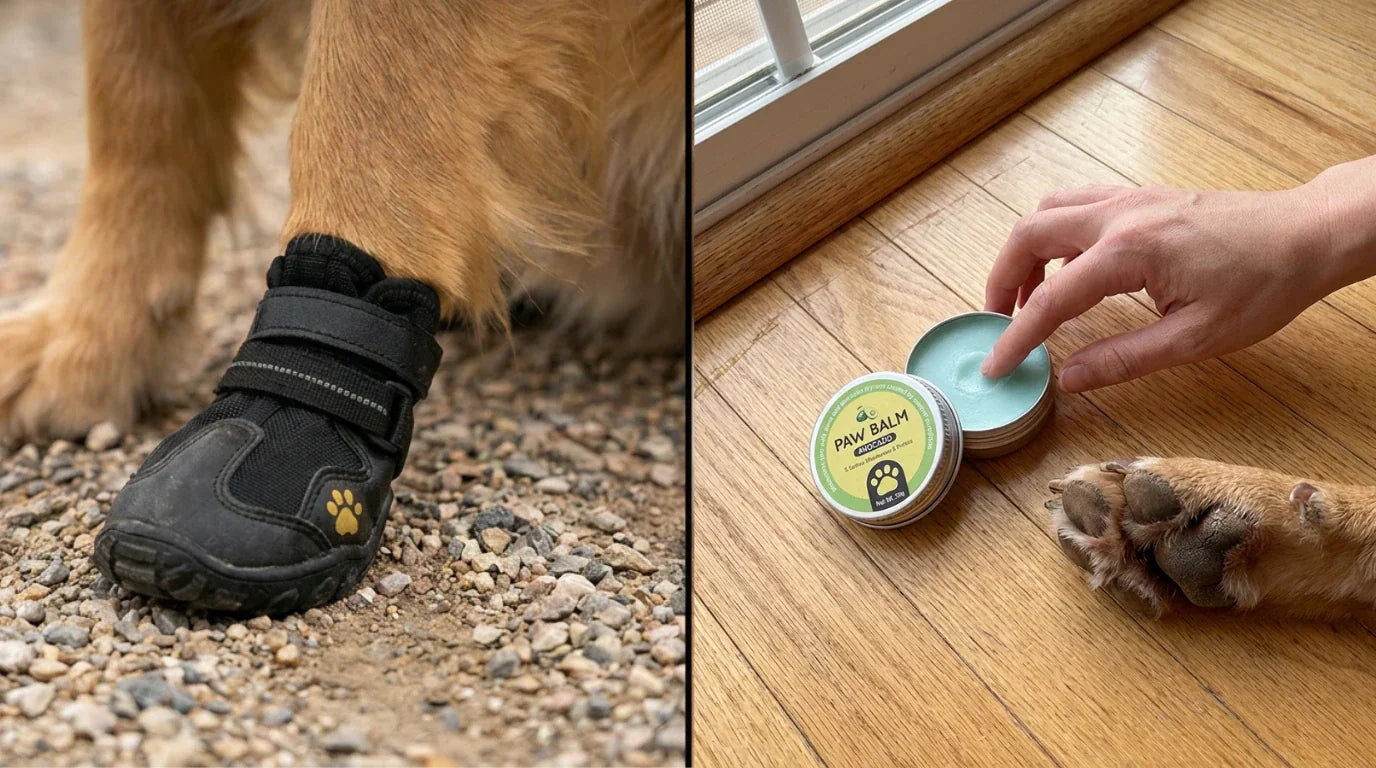
This isn't an either/or question, because boots and balm protect paws in fundamentally different ways.
Dog boots provide mechanical protection against sharp objects, extreme cold contact, and abrasive surfaces. They're physical barriers between paws and ground.
Paw balm provides chemical and thermal protection against salt damage, heat absorption, moisture loss, and tissue regeneration. It's biochemical protection at the cellular level.
These aren't competing solutions, they're complementary.
Boots don't prevent salt burns (salt penetrates through boot seams and after removal). Balm doesn't prevent cuts from sharp rocks or glass.
The question isn't which one is better, it's which protection does your dog actually need, and in many cases, the answer is both.
Here's what each option does well, where each one fails, and how to decide what your dog needs.
What Dog Boots Actually Do Well
Let's start with what boots are genuinely good at:
1. Mechanical Protection Against Sharp Objects
Boots excel at preventing:
- Rock cuts and abrasions on trails
- Glass shards on urban sidewalks
- Thorns and burrs in brush
- Sharp ice crystals
- Gravel embedded in paw pads
If your dog walks where sharp objects are the primary threat, rocky trails, construction zones, areas with broken glass, boots provide protection balm cannot.
Balm creates a biochemical barrier but not a physical one. A sharp rock will cut through balm-protected paws just as easily as unprotected paws.
2. Extreme Cold Contact Protection
Boots insulate paws from direct contact with:
- Sub-zero pavement (below -10°F)
- Snow/ice for extended periods (30+ minutes)
- Metal surfaces in freezing weather
For dogs who spend extended time outdoors in extreme cold—working dogs, sled dogs, dogs living in Arctic climates—boots prevent frostbite better than balm alone.
Balm prevents chemical damage and seals moisture, but it doesn't create thermal insulation equivalent to a physical barrier.
3. Post-Injury Protection During Healing
Boots keep injured paws clean and protected:
- After surgery or vet treatment
- During crack healing (prevents dirt contamination)
- Burns or abrasions that need mechanical protection
- Bandage coverage for severe injuries
When paws are actively healing, boots prevent licking, keep wounds clean, and protect fragile new tissue from mechanical stress.
4. Senior Dogs with Mobility Issues
Boots can help senior dogs with:
- Traction on slippery floors (non-slip soles)
- Dragging paws (protective barrier against abrasion)
- Reduced pain sensation (cushioning effect)
For senior dogs who drag their paws or have reduced mobility, boots provide mechanical protection that prevents injuries from friction.
Where Dog Boots Fail
Now here's what boots DON'T do and these failures matter:
1. Boots Don't Prevent Chemical Damage
The biggest misconception about boots:
Road salt penetrates boot seams. Boots aren't waterproof barriers—they're fabric/rubber with stitching, velcro, and gaps where paws meet ankle.
Salt water seeps through during walks, sits against paw tissue, and causes osmotic burns while the dog is wearing boots.
When you remove boots after a winter walk, paws are often wetter and more exposed to salt than if you'd used balm alone—because the boots trapped salt-contaminated moisture against tissue.
Boots create a false sense of security. Owners think "my dog has boots, paws are protected"—but chemical damage is happening inside the boot.
Related: How road salt causes osmotic burns at the cellular level
2. Boots Don't Prevent Thermal Damage
In summer, boots make heat worse:
Hot pavement (140°F+) heats the boot material, which then traps heat against paw pads. The boot becomes an oven.
Most dog boots are designed for winter, they're insulated to keep paws warm. In summer, that insulation traps thermal energy rather than dissipating it.
Dogs wearing boots on hot pavement often show more thermal distress than dogs with lightweight heat-protective balm, because the balm allows heat dissipation while boots trap it.
Boots also prevent evaporative cooling, dogs' paws sweat to regulate temperature. Boots block this mechanism.
3. Boots Don't Support Healing
Boots are mechanical barriers, they don't accelerate tissue repair.
Cracked paw pads need regenerative nutrients (omega-7 fatty acids, vitamins, moisturizing compounds) to stimulate keratin synthesis and epithelial regeneration.
Boots keep wounds clean but don't speed healing. A crack covered by a boot for two weeks heals at the same rate as an uncovered crack, no acceleration.
Healing balms with sea buckthorn omega-7 accelerate regeneration 40-60% compared to passive protection. Boots don't offer this benefit.
Deep dive: How to heal cracked paw pads in 7-14 days with regenerative protocols
4. Most Dogs Refuse to Wear Boots
This is the practical dealbreaker:
Dogs hate boots. Not all dogs, but most dogs.
The first time you put boots on a dog, you get:
- High-stepping gait (trying to shake them off)
- Refusal to walk
- Stress signals (panting, whining)
- Velcro-chewing within 30 seconds
Some dogs acclimate with training—but it takes weeks of gradual exposure and positive reinforcement. Many owners give up after two walks.
Boots also require proper fit—too tight causes circulation issues, too loose falls off. Finding the right size is trial and error (and expensive).
Balm has zero acclimation requirement. You apply it, dog walks normally. No behavioral resistance.
What Paw Balm Actually Does Well
Now let's look at balm's genuine strengths:
1. Chemical Protection (Salt, Ice Melt, Allergens)
Balm creates a pH-buffered barrier that:
- Blocks salt/chemical penetration into keratin tissue
- Prevents osmotic stress (salt drawing moisture from cells)
- Maintains skin barrier integrity (reduces inflammation)
- Protects against ice melt chemicals (calcium chloride, magnesium chloride)
Winter Shield formula (shea butter-based, pH-buffered) blocks salt absorption at the molecular level, not just physical coverage but biochemical protection.
Boots can't do this. Salt water seeps through, sits against tissue inside boot, causes damage.
Chemical breakdown: Why calcium chloride is more damaging than sodium chloride
2. Thermal Protection Without Heat Trapping
Summer balm (coco butter-based) reduces thermal conductivity without creating occlusive barriers:
- Lightweight oils absorb into keratin (don't sit on surface)
- Reduce heat transfer rate from pavement to tissue
- Allow evaporative cooling (don't block sweat glands)
- Don't trap heat like insulated boots do
Hot pavement at 145°F causes burns through contact time + conductivity. Balm reduces conductivity without preventing heat dissipation.
Boots trap heat—the material itself heats up and holds temperature against paws.
3. Healing and Regeneration
Healing balms (sea buckthorn omega-7) actively accelerate tissue repair:
- Omega-7 fatty acids stimulate keratin synthesis at cellular level
- Penetrate damaged tissue (don't just coat surface)
- Reduce inflammation (support healing environment)
- Accelerate epithelial regeneration 40-60% vs passive protection
Cracked paws heal in 7-14 days with omega-7 balm vs 3-4 weeks with passive protection (boots or petroleum jelly).
Boots keep wounds clean. Balm actively heals them. Big difference.
4. Daily Use Practicality
Balm is practical for everyday use:
- 30-second application (vs 2-3 minutes per boot)
- No sizing issues (one size fits all paws)
- No acclimation period (dogs tolerate immediately)
- Doesn't fall off during walk
- Works on all terrain (trails, pavement, snow, sand)
- Year-round versatility (seasonal formulas for different threats)
For daily paw maintenance, the routine protection most dogs need, balm is significantly more practical than boots.
5. Cost Efficiency Over Time
Boots: $40-80 per set, replaced every 3-6 months (wear/tear), plus sizing trial-and-error
Balm: $15-25 per 2oz tin, lasts 3-4 months with daily use
Annual cost:
- Boots: $80-160+ (multiple replacements, sizing mistakes)
- Balm: $45-75 (3-4 tins per year)
Balm is roughly half the cost over a year of daily use.
Where Paw Balm Fails
Balm isn't perfect either. Here's where it underperforms:
1. Balm Doesn't Prevent Sharp Object Cuts
Balm creates biochemical protection, not mechanical armor.
A sharp rock, glass shard, or thorn will cut through balm-protected paws just as easily as unprotected paws.
If your dog walks on trails with sharp rocks, construction zones, or areas with glass/debris, balm alone is insufficient. You need mechanical protection.
2. Balm Doesn't Prevent Frostbite in Extreme Cold
For working dogs in Arctic conditions (sled dogs, search/rescue in sub-zero temps):
Balm prevents chemical damage and seals moisture, but doesn't create physical insulation equivalent to boots.
Extended exposure (30+ minutes) to extreme cold (below -10°F) can cause frostbite even with balm protection.
Boots provide better thermal insulation for extreme cold contact.
3. Balm Requires Reapplication
After swimming, heavy rain, or extended activity, balm wears off.
Boots stay on (assuming they fit properly and dog doesn't remove them).
For multi-hour hikes or water activities, you need to reapply balm every 2-3 hours. Boots don't require this.
4. Balm Doesn't Keep Wounds Clean During Healing
For post-surgical paws or severe injuries, balm promotes healing but doesn't prevent dirt contamination the way a boot does.
Boots + bandages keep wounds sterile during recovery. Balm alone doesn't provide this mechanical barrier.
When to Use Boots (And Only Boots)
Boots are the right choice when:
1. Sharp Objects Are Primary Threat
- Rocky trails with loose gravel
- Construction zones
- Areas with broken glass
- Thorny brush
In these environments, mechanical protection is non-negotiable. Balm won't prevent cuts.
2. Extreme Cold for Extended Periods
- Sled dogs working in sub-zero temps
- Search/rescue in Arctic conditions
- Dogs spending 30+ minutes outdoors below -10°F
For extreme cold exposure, boots provide superior thermal insulation.
3. Post-Surgical Recovery
- After paw surgery or vet procedures
- Severe injuries requiring sterile environment
- Bandage protection
Boots keep wounds clean and protected during healing.
4. Senior Dogs with Mobility Issues
- Dragging paws (abrasion protection)
- Slippery floor traction
- Reduced pain sensation (cushioning)
Boots provide mechanical support and traction for mobility-impaired dogs.
When to Use Balm (And Only Balm)
Balm is the right choice when:
1. Chemical Threats Are Primary
- Road salt exposure (winter walks)
- Ice melt chemicals
- Pool chlorine
- Beach salt water
Boots don't prevent chemical damage. Balm does.
2. Thermal Threats (Hot or Cold)
- Hot summer pavement (140°F+)
- Moderate winter cold (above 0°F)
- Temperature fluctuations
Balm provides thermal protection without heat trapping.
3. Daily Maintenance and Prevention
- Year-round paw health
- Moisture retention
- Keratin flexibility
- General protection
For routine daily use, balm is more practical than boots.
4. Healing Cracked or Dry Paws
- Active cracks or bleeding
- Chronic dryness
- Hyperkeratosis
- Post-injury tissue repair
Balm accelerates healing. Boots only passively protect.
When to Use BOTH (The Optimal Approach)
For many dogs, the best solution is boots + balm together:
WINTER: Boots + Winter Shield Balm
Application sequence:
- Apply Winter Shield balm (blocks salt penetration)
- Let absorb 2-3 minutes
- Put boots on (mechanical protection against ice/snow)
- After walk, remove boots
- Rinse paws (remove salt that seeped through)
- Reapply balm (repair any damage, seal moisture)
Why both: Balm prevents chemical damage that boots can't stop. Boots prevent mechanical damage from ice/snow that balm can't stop.
SUMMER: Boots + Summer Cool Shield Balm (Rare)
Most dogs don't need boots in summer—but for extreme heat on unavoidable pavement:
- Apply Summer Cool Shield (thermal protection)
- Put lightweight, breathable boots on (if pavement >150°F)
- Keep walks under 15 minutes (boots trap heat)
Important: This is last resort for extreme heat. Better solution is walk during cooler hours (before 10am, after 6pm) with balm only.
TRAILS: Boots + All-Season Shield Balm
For rocky trails with sharp terrain:
- Apply All-Season Shield (moisture retention, abrasion resistance)
- Put boots on (mechanical protection against rocks)
- Remove boots every 2-3 miles (check for hot spots, reapply balm)
Why both: Boots prevent cuts, balm prevents chafing and moisture loss from friction.
POST-INJURY: Boots + Sea Buckthorn Healing Balm
During healing phase:
- Apply Sea Buckthorn Healing twice daily (accelerates regeneration)
- Put boot on when outdoors (keeps wound clean)
- Remove boot indoors (allow air circulation)
- Reapply balm after boot removal
Why both: Balm heals tissue faster, boots keep healing paws clean during outdoor activity.
Cost Comparison: Boots vs Balm vs Both
Annual Cost Breakdown (One Dog):
Boots Only:
- Initial purchase: $50-80
- Replacement (2x/year): $100-160
- Total: $150-240/year
Balm Only (Seasonal System):
- Winter Shield: $20 (lasts 3 months)
- Summer Cool Shield: $20 (lasts 3 months)
- All-Season Shield: $20 (lasts 6 months)
- Sea Buckthorn (as needed): $20
- Total: $60-80/year
Boots + Balm:
- Boots: $150-240/year
- Balm: $60-80/year
- Total: $210-320/year
INSIGHT: Balm alone costs 40-50% less than boots. Boots + balm costs 2-3x more than balm alone.
For most dogs (suburban/urban, daily walks, no extreme conditions), balm provides 80% of needed protection at 40% of the cost.
Convenience Comparison
| Factor | Boots | Balm | Winner |
|---|---|---|---|
| Application time | 2-3 min/walk | 30 sec/walk | Balm |
| Dog tolerance | Varies (many resist) | High (no resistance) | Balm |
| Sizing required | Yes (trial/error) | No (universal) | Balm |
| Stays on during walk | Sometimes (50-70%) | Always | Tie |
| Reapplication needed | No | Every 2-3 hours | Boots |
| Works in all seasons | No (winter-designed) | Yes (seasonal formulas) | Balm |
| Travel-friendly | Bulky | Compact tin | Balm |
Balm wins on convenience for daily use. Boots win on "set it and forget it" for individual walks.
Dog Tolerance: What Actually Happens
BOOTS:
First-time boot wearers typically:
- High-step walk (trying to shake off)
- Freeze and refuse to move
- Chew velcro/straps within seconds
- Show stress signals (panting, whining)
With gradual training:
- 30-40% of dogs acclimate within 2-3 weeks
- 40-50% tolerate but never love them
- 10-30% refuse indefinitely
BALM:
First application:
- Dogs may sniff/lick briefly
- Resume normal walking within 30 seconds
- No behavioral resistance
- No acclimation period needed
Exception: Some dogs lick obsessively if formula is too heavy. Solution: switch to lighter formula (coco butter or avocado vs shea butter).
Recommendations by Situation
URBAN/SUBURBAN DOG (Sidewalks, Parks, Occasional Trails)
Use: Balm only (seasonal formulas)
- Winter Shield for salt/cold
- Summer Cool Shield for heat
- All-Season Shield for mild weather
- Sea Buckthorn if injuries occur
Skip boots unless: Dog refuses to walk on salt without them, or local ordinances require (rare)
TRAIL/HIKING DOG (Rocky Terrain, Sharp Objects)
Use: Boots + All-Season Shield Balm
- Boots for mechanical protection (cuts/abrasions)
- Balm for moisture retention and minor chafing protection
- Remove boots every 2-3 miles to check for hot spots
WORKING DOG (Sled, Search/Rescue, Extreme Conditions)
Use: Boots + Winter Shield Balm
- Boots for extreme cold insulation and mechanical protection
- Balm for chemical protection and healing minor abrasions
- Daily paw inspection for early injury detection
BEACH/WATER DOG (Swimming, Sand, Salt Water)
Use: Balm only (Summer Cool Shield)
- Pre-swim application
- Rinse thoroughly post-swim
- Reapply after drying
- Boots not needed (sand rarely sharp enough to cause cuts)
SENIOR DOG (Mobility Issues, Dragging Paws)
Use: Boots for traction + All-Season Shield for skin health
- Non-slip sole boots for indoor traction
- Protective boots outdoors (prevent dragging abrasion)
- Daily balm application for tissue health
INJURED DOG (Healing Phase)
Use: Boots outdoors + Sea Buckthorn Healing Balm twice daily
- Boots keep wounds clean during walks
- Balm accelerates healing
- Remove boots indoors (allow air circulation)
Common Questions: Boots vs Balm
"Can I use boots without balm?"
Yes, but you're missing chemical/thermal protection.
Boots prevent mechanical damage but don't prevent salt burns, heat absorption, or support healing. Most dogs benefit from both.
"Can I use balm without boots?"
Yes, for most situations this is sufficient.
80% of dogs (suburban/urban, no extreme conditions) don't need boots. Balm handles daily chemical and thermal threats effectively.
"My dog refuses boots. What do I do?"
Use balm instead. For most threats (salt, heat, dryness), balm provides adequate protection without behavioral resistance.
If boots are truly necessary (extreme cold, post-surgery), work with a trainer on gradual desensitization.
"Which boots work with balm?"
Breathable, non-insulated boots work best with balm:
- Avoid heavy rubber soles (trap heat)
- Choose fabric/mesh uppers (allow some air flow)
- Ensure proper fit (not too tight after balm application)
Apply balm first, let absorb 2-3 minutes, then put boots on.
"Does balm make boots slip off?"
It can if you apply too much.
Solution: Apply thin layer of balm, let absorb fully (2-3 minutes), then put boots on. Most slippage comes from excess product, not the balm itself.
The Real Answer: It's Not Either/Or
Dog boots and paw balm protect paws differently.
Boots = mechanical protection against cuts, extreme cold, post-injury coverage
Balm = chemical protection against salt/heat, healing acceleration, daily maintenance
For most dogs in typical conditions, balm alone is sufficient and more practical.
For dogs facing extreme conditions or specific threats, boots + balm together provide optimal protection.
The question isn't "which is better" it's "which threats does my dog actually face?"
Match the protection to the threat, not the product to the marketing.
Different problems require different solutions. Sometimes that's balm. Sometimes that's boots. Often it's both.