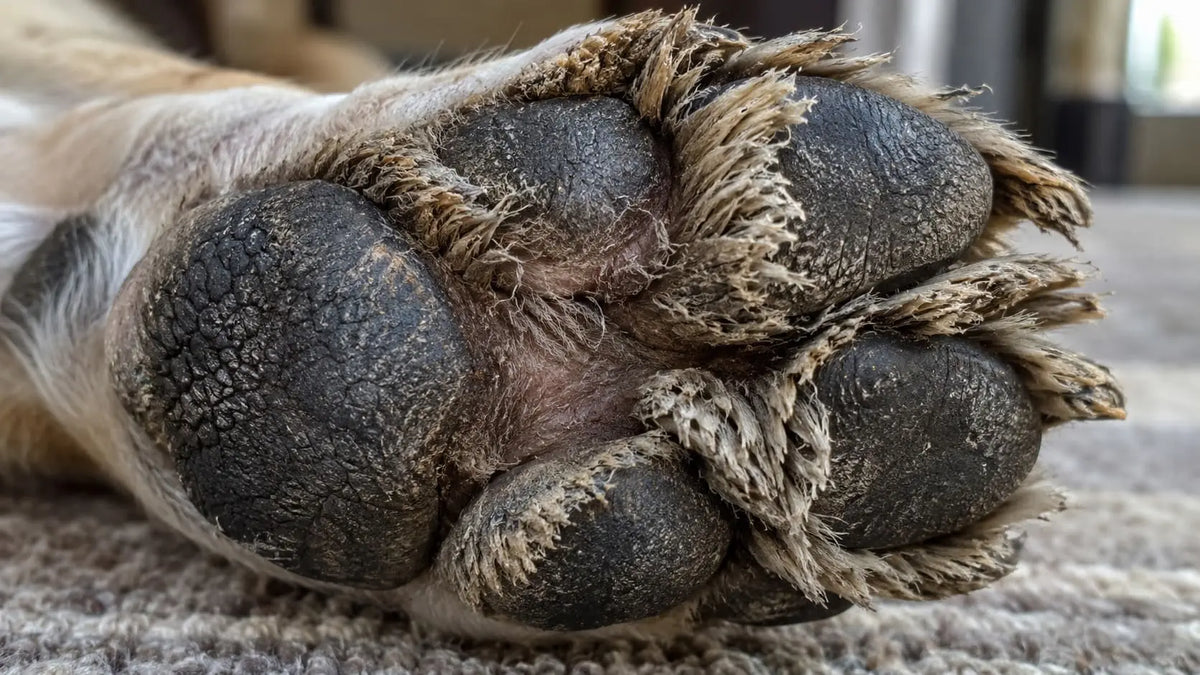
You're giving your dog a belly rub, or wiping their feet after a walk, and you notice something odd. The edges of the paw pads look fuzzy. Almost like little hairs, bristles, or tiny feathers sticking out of the pad. Some people say it looks like shredded wheat. Others say it looks like the pad is "growing a beard."
It's a strange thing to see, and it's natural to wonder if something is wrong.
Here's the reassuring part first: those aren't hairs, and in most dogs this is common and manageable. Here's what's actually going on, and what you can do about it.
Those "hairs" are actually keratin
Your dog's paw pads are covered in a tough outer layer made of keratin, the same protein that makes up your fingernails. The body is constantly producing new keratin and shedding the old, worn-out layer. In a healthy pad, those two things stay in balance.
Sometimes the balance tips. The skin starts making more keratin than it sheds, and the extra has nowhere to go. Instead of wearing away, it builds up and pushes outward in thin, stiff strands. Those strands are what you're seeing.
This is called hyperkeratosis. When it grows in those fine, hair-like strands, people often call it "hairy paw pads" or "keratin feathers." Vets sometimes use the longer name nasodigital hyperkeratosis when it shows up on both the paws and the nose.
So when your dog's pads look hairy, what you're really seeing is overgrown pad skin, not fur.
Where it usually shows up
Hairy pads tend to start in the same places:
- Along the edges of the pads, especially the outer rim, where there's less daily friction to wear the keratin down
- On the toe pads more than the big central pad
- On the parts of the paw that touch the ground least
That last point is the giveaway. The areas that get walked on wear the keratin off naturally. The areas that don't make contact are where it piles up, which is why the "fringe" usually sits around the sides rather than right in the middle.
Many dogs also get it on their nose at the same time. If your dog's nose looks dry, thick, or crusty on top, it's very likely the same thing. We've written about that in our guide to nose hyperkeratosis.
Why some dogs get hairy paw pads
There usually isn't one single cause. These are the most common reasons:
1. Age. This is the big one. As dogs get older, their skin renews itself more slowly and keratin tends to build up. Plenty of dogs develop fuzzy pad edges somewhere after age 7 or 8, often with no other problem at all. It's one of the many small changes we cover in senior dog paw care.
2. Breed. Some breeds are simply more prone to it. Labradors, Golden Retrievers, Cocker Spaniels, Boxers, Bulldogs, and Dogues de Bordeaux show up again and again. A few breeds, like the Irish Terrier, can even inherit a form that starts when they're young.
3. No clear reason at all. In a lot of dogs, especially older ones, the overgrowth just happens. This "idiopathic" form is the most common type, and it's usually harmless as long as it's kept under control.
4. An underlying health issue (less common). Occasionally, thick or hairy pads are a sign of something else going on in the body, like a zinc deficiency, an autoimmune skin condition, or, rarely, an infection. In those cases there are usually other signs too, which we'll get to below.
Does it hurt?
Mild hairy pads usually don't bother a dog at all. Lots of dogs have a little fringe on their pads for years without ever noticing.
The trouble starts when it builds up. Thick keratin is hard and inflexible. When it gets too thick, it can:
- Crack, sometimes deeply enough to bleed
- Catch on carpet, grass, or rough ground and tear
- Change the way your dog puts weight on the paw, so they walk more carefully or even limp
- Make walking on hard or cold surfaces uncomfortable
A dog with sore pads usually won't cry out. They just adjust, slowing down, hesitating on stairs, or licking their paws more than usual. That's why it's worth keeping an eye on it before it gets to that stage.
Can you trim it off?
This is one of the most common questions, and the honest answer is: sometimes, but carefully, and usually not as the first step.
The strands are dead keratin, so trimming the very tips doesn't hurt. But the line between dead keratin and living, sensitive pad tissue isn't always easy to see. Cut too close and you can cause pain and bleeding.
A few ground rules if you do trim:
- Soften first. Never trim hard, dry keratin. Soak or apply balm beforehand so it's pliable.
- Take off only the loose, overhanging tips. Leave anything firmly attached.
- Stop the moment you see pink or moist tissue.
- When in doubt, don't. Ask your vet or groomer to show you the first time.
For most dogs, softening the keratin is more effective than cutting it, because it treats the whole pad rather than just the tips you can see. Trimming without softening tends to bring the "hairs" right back.
What actually helps
Since the problem is too much keratin building up, the goal is to soften it and help the pad shed it the way it's supposed to. You're not trying to scrape it off. You're trying to make the skin flexible again.
Here's a simple routine that works for most dogs:
1. Start with a warm soak. A few minutes of warm (not hot) water softens hard keratin so it becomes pliable. A shallow bowl or a damp, warm washcloth held on the paw both work. This step matters more than any product you use afterward.
2. Pat dry gently. Don't rub hard. Thick, overgrown skin can tear if it's handled roughly.
3. Apply a softening balm while the pad is still slightly damp. This is when the skin absorbs best. Work it into the pad and the fuzzy edges for a few seconds.
4. Repeat daily. Keratin buildup didn't happen overnight, and it won't soften overnight either. Most dogs start to look and feel better within a few weeks of steady care.
5. Keep going once it improves. Hairy pads are usually a long-term tendency, not a one-time problem. If you stop completely, the buildup tends to come back. A lighter maintenance routine, a few times a week, keeps it in check.
Choosing what to put on it
Not every balm helps here. Products that just sit on the surface, like petroleum jelly or plain coconut oil, make the pad look shiny for a while but don't really soften keratin that's built up underneath. And your dog will probably lick them off.
What you want is something that soaks into the pad and helps the skin renew itself properly. That's why we rely on sea buckthorn oil, which is naturally rich in omega-7, a fatty acid that absorbs into the deeper layers of the skin and supports healthy skin turnover. Paired with a warm soak, it helps soften thick keratin from the inside instead of just coating it.
Whatever you choose, make sure it's:
- Safe if licked, because your dog will lick it
- Free of added fragrances, which can irritate skin
- Meant for dogs, not a human foot cream
If you want the full step-by-step version, our hyperkeratosis treatment protocol goes deeper.
When to call your vet
Most hairy paw pads are simple age- or breed-related buildup. But check in with your vet if:
- It appears suddenly, especially in a young or middle-aged dog with no history of it
- The pads crack and bleed, or there's swelling, heat, pus, or a bad smell
- Your dog is limping or clearly doesn't want to walk
- It's spreading to other areas, like the nose, ears, elbows, or other patches of skin at the same time
- Your dog seems unwell in other ways, such as tiredness, weight loss, poor appetite, or a dull coat
- The pads also look crusty, scabby, or are peeling in sheets, which can point to a different problem (see our guide to paw pad peeling)
- Nothing improves after several weeks of consistent softening care
A vet can rule out the less common causes and, if needed, help with trimming the first time so you can see how it's done safely.
The bottom line
If your dog's paw pads look hairy, you're looking at extra keratin, not fur, and in most dogs it's a common, manageable part of getting older or of their breed. It only becomes a real problem when it builds up enough to crack or make walking uncomfortable.
A few minutes a day of warm soaking and the right balm keeps those "feathers" soft, flexible, and under control, so your dog can keep walking comfortably.

If you're looking for something made for exactly this, our Sea Buckthorn Healing Balm is built around omega-7-rich sea buckthorn oil to soften thickened pads and noses, absorbs without a greasy film, and is safe if your dog licks it. One balm for the paws and the nose, because hairy pads and a crusty nose so often go together.
Flip the paw over, feel those edges, and start softening. Your dog's feet will thank you.
Frequently Asked Questions
Why do my dog's paw pads look hairy?
The "hairs" are extra keratin, the tough protein that forms the outer layer of the paw pad. When the skin produces more keratin than it sheds, the excess builds up and grows outward in thin, stiff strands that look like hair. This is a form of hyperkeratosis.
Is hairy paw pad hyperkeratosis painful for dogs?
Mild cases usually aren't painful. It becomes uncomfortable when the keratin gets thick enough to crack, catch on surfaces, or change how your dog walks. Limping, licking, or hesitating on hard floors are signs it's bothering them.
Can I cut the hair-like growths off my dog's paw pads?
You can trim the loose, overhanging tips after softening them, but cut cautiously and stop if you see pink or moist tissue. Softening the keratin with warm soaks and a penetrating balm is usually more effective and safer than trimming alone.
What breeds get hairy paw pads?
It's especially common in Labradors, Golden Retrievers, Cocker Spaniels, Boxers, Bulldogs, and Dogues de Bordeaux, and in senior dogs of any breed. Some breeds, such as the Irish Terrier, can inherit a form that starts young.
Can hairy paw pads be cured?
In most dogs it's a long-term tendency that can be managed rather than cured. Regular softening keeps the buildup under control, but it usually returns if care stops completely. If an underlying condition is causing it, treating that condition can help.
When should I see a vet about hairy paw pads?
See your vet if it appears suddenly, the pads crack or bleed, your dog limps, it spreads to other parts of the body, your dog seems unwell, or there's no improvement after several weeks of consistent care.