Written by Dr. Marcus Chen, DVM | May 12, 2026
Why Is My Dog Limping? A Veterinarian's Paw Injury Detection Guide
Your dog is limping. You're worried. You need answers fast.
I see this scenario weekly in my Minneapolis practice. Owner walks in carrying a 65-pound dog or coaxing a reluctant senior, both terrified about what's wrong.
The good news: most limping in dogs is paw-related and treatable at home.
The bad news: some limping signals serious problems requiring immediate veterinary care.
This guide helps you tell the difference.
I'll walk you through:
- Quick assessment: Is it the paw or something else?
- 5 common paw causes of limping (with specific symptoms)
- Step-by-step paw inspection (exactly how to check)
- Red flags requiring immediate vet visit
- Home treatment for minor paw injuries
- Healing timelines so you know what to expect
Before we start: If your dog is in severe pain, can't bear any weight on the leg, has visible bone abnormality, or is bleeding heavily, stop reading and go to your vet now. This guide is for moderate limping where home assessment is appropriate.
For everything else, let's figure out what's happening with your dog's paw.
Quick Assessment: Is It the Paw or Something Else?
Before diving into paw inspection, rule out non-paw causes.
Dogs limp for many reasons and about 60% of limping cases I see ARE paw-related, but 40% are joint, muscle, or skeletal issues that require different evaluation.
Signs limping is likely PAW-related:
✓ Dog favors one specific paw (consistently lifting or protecting it)
✓ Limping started suddenly (was fine yesterday, limping today)
✓ Dog licks or chews the paw repeatedly
✓ You see visible signs on the paw (redness, swelling, foreign object)
✓ Limping worsens on certain surfaces (hard floors, sharp gravel)
✓ Dog tolerates pressure on the leg above the paw
Signs limping is likely NOT paw-related:
✗ Limping affects whole leg (not specific to paw)
✗ Dog has trouble rising from lying down
✗ Limping worse after rest, improves with movement (typical of joint issues)
✗ Multiple legs affected (suggests systemic issue)
✗ Limping started gradually over weeks (suggests chronic joint/muscle problem)
✗ Dog yelps when you touch hip, knee, or shoulder area
If symptoms suggest non-paw causes, joint disease, ligament injuries, muscle strain, this guide won't fully address those. See your vet for proper evaluation.
If symptoms suggest paw involvement, continue reading.
The 5 Most Common Paw-Related Causes of Limping
In my practice, these five paw issues account for about 85% of paw-related limping cases.
1. Foreign Object Lodged in Paw
The single most common cause I see.
What it looks like:
- Sudden limping (was fine before walk, limping after)
- Dog repeatedly licks one specific paw
- Visible object between toes or in pad
- Dog refuses to put weight on affected paw
Common foreign objects:
- Thorns and burrs (especially after trail walks)
- Glass shards (urban sidewalks)
- Wood splinters (yards, parks)
- Small rocks lodged between toes
- Grass seeds/foxtails (can migrate deep into tissue)
Why this is #1: Dogs walk on everything. Their paws function like our hands but without the visibility we have when something embeds.
A patient of mine, a 4-year-old border collie, started limping severely after a hike. Owner couldn't see anything obvious. Examination revealed a tiny piece of glass embedded between toes, 1mm deep, completely invisible until I spread the toes apart.
Treatment: Remove the object (if accessible), clean wound, apply antiseptic, monitor for infection.
When to see vet: Object is deeply embedded, you can't remove it, signs of infection (pus, severe swelling, fever).
2. Cracked or Torn Paw Pad
Second most common cause and often missed by owners.
What it looks like:
- Limping that worsens on hard surfaces
- Visible crack, split, or tear in paw pad
- Sometimes bleeding (can be minimal)
- Dog avoids putting full weight on affected paw
Common causes of cracks/tears:
- Sharp objects (rocks, glass, ice)
- Excessive activity on hard surfaces (concrete, asphalt)
- Hot pavement burns (140°F+ in summer)
- Cold/salt damage (winter conditions)
- Chronic dryness (dehydrated pad tissue)
A common scenario: Owner reports dog "limping for no reason"—but examination shows a hairline crack along the side of the pad, often invisible without spreading the paw and looking carefully.
These cracks are painful because pad tissue has dense nerve endings. Even small cracks can cause significant limping.
Treatment: Clean the area, apply healing balm with omega-7 fatty acids (accelerates regeneration 40-60%), restrict activity until crack closes.
Complete healing protocol: How to heal cracked paw pads in 7-14 days
When to see vet: Crack is deep enough to see underlying tissue, heavy bleeding, signs of infection, no improvement after 5-7 days of home treatment.
3. Burned Paw Pads (Thermal or Chemical)
Underdiagnosed, especially in summer.
What it looks like:
- Limping after walk on hot pavement or salted surfaces
- Pads appear darker than normal or have black patches
- Pads feel rough, blistered, or peeling
- Dog refuses to walk on hard surfaces
Thermal burns (summer):
- Pavement temperatures reach 145°F at just 90°F air temp
- Burns occur in 60 seconds of contact
- Symptoms: limping, pad discoloration, blistering
Chemical burns (winter):
- Road salt and ice melt cause osmotic burns
- Calcium chloride is especially damaging
- Symptoms: limping, redness, peeling, bleeding cracks
A patient last August: 7-year-old Lab brought in limping. Owner had walked her at 2pm on July 90°F day. All four pads showed second-degree burns, she'd walked on 140°F sidewalk for 10 minutes.
Treatment: Cool the paws (lukewarm water, not ice), apply healing balm, restrict activity for 7-10 days, soft surfaces only during recovery.
When to see vet: Severe blistering, exposed tissue under burned layer, signs of infection, dog won't bear weight at all.
Critical guide: The 7-second test to prevent hot pavement burns
4. Torn Toenail (Including Dewclaw)
Common but often overlooked as cause of limping.
What it looks like:
- Sudden limping (often after running or catching nail on something)
- Visible damaged nail (cracked, split, hanging)
- Sometimes bleeding (can be heavy from quick exposure)
- Dog repeatedly licks the affected paw
Common scenarios:
- Nail catches on carpet, fabric, or outdoor surfaces
- Running on hard surfaces can split brittle nails
- Dewclaws (the "thumb" nail) catch frequently
- Senior dogs with brittle nails more susceptible
Why nails cause significant limping: The nail "quick" (blood and nerve supply) extends into the nail. Any tear or break exposes this sensitive tissue, causing pain similar to a torn fingernail in humans.
Treatment depends on severity:
Minor crack (no quick exposure):
- Trim damaged portion
- Apply styptic powder if bleeding
- Protect with bandage if needed
- Healing time: 1-2 weeks
Major break (quick exposed):
- Apply pressure to stop bleeding (can take 5-10 minutes)
- Clean with antiseptic
- See vet for proper trimming and bandaging
- Healing time: 2-4 weeks
When to see vet: Heavy bleeding that won't stop, quick exposed, full nail torn off, signs of infection.
5. Insect Sting or Bite on Paw
Surprisingly common, especially in spring and summer.
What it looks like:
- Sudden severe limping (dog yelps suddenly)
- Visible swelling on paw or between toes
- Sometimes red mark or stinger visible
- Dog frantically licks the affected area
Common culprits:
- Bee/wasp stings (most common, especially when dogs investigate flowers)
- Spider bites (less common but more serious)
- Ant bites (especially fire ants in southern climates)
- Tick bites (slower onset, may not cause immediate limping)
A patient last spring: 2-year-old golden retriever brought in limping severely, paw swollen to twice normal size. Bee sting between toes—visible red puncture mark.
Treatment:
- Remove stinger if visible (scrape with credit card, don't squeeze with tweezers)
- Apply cold compress (reduces swelling)
- Monitor for allergic reaction (severe swelling spreading up leg, difficulty breathing)
- Antihistamines may help (consult vet for dosage)
When to see vet IMMEDIATELY:
- Swelling spreading up leg
- Difficulty breathing
- Multiple stings
- Pale gums or weakness
- Vomiting or collapse
This can be life-threatening for allergic dogs, don't wait if symptoms worsen.
Step-by-Step Paw Inspection Guide
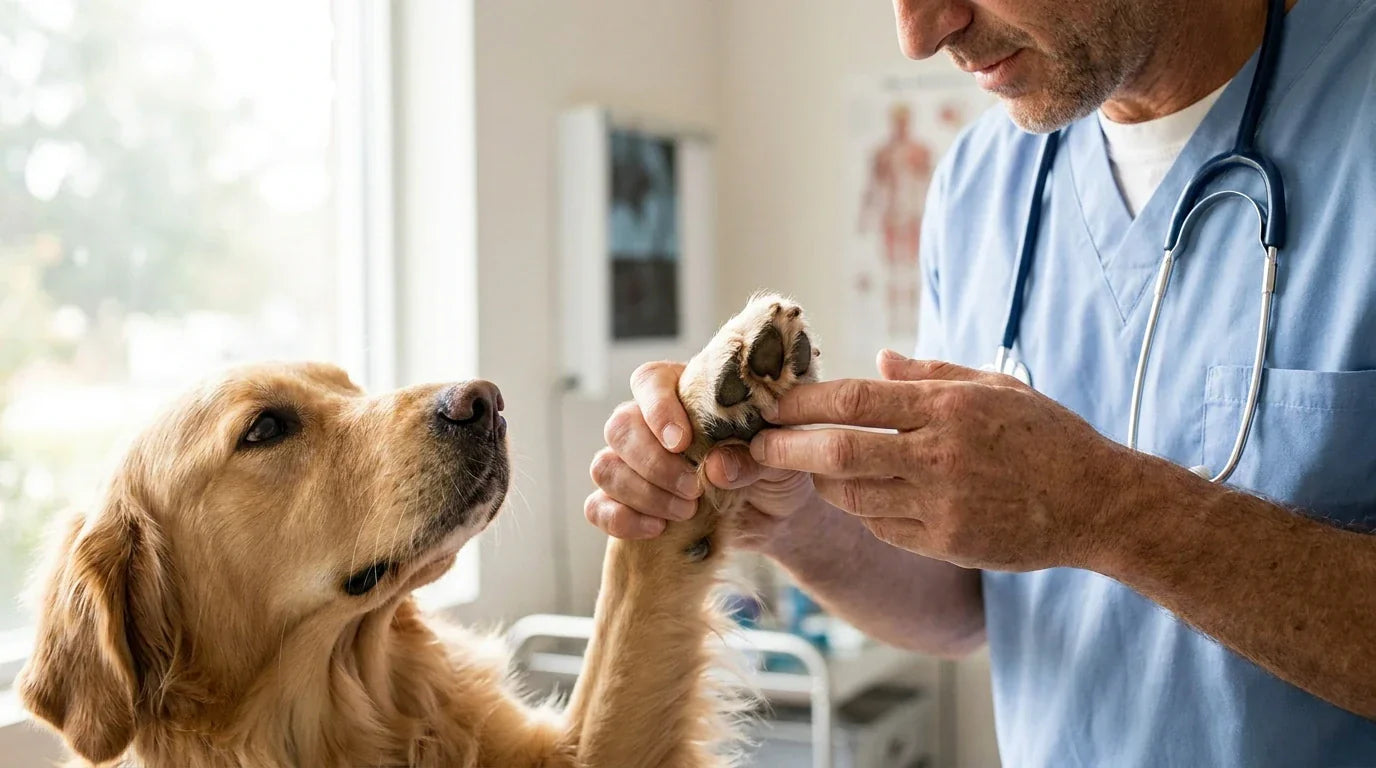
Here's exactly how I inspect a paw in my practice, you can do this at home.
Setup:
- Calm environment (no other animals, quiet room)
- Good lighting (natural light or bright lamp)
- Have supplies ready: Damp washcloth, tweezers, magnifying glass, treats for distraction
- Position dog comfortably (lying on side preferred, or standing for cooperative dogs)
STEP 1: Observe Before Touching
Before handling the paw, watch how your dog moves:
- Which paw is favored?
- Does dog refuse to bear ANY weight, or just less weight?
- Does limping worsen on certain surfaces?
- Is dog licking one specific paw repeatedly?
This tells you which paw to focus on and rules in/out paw involvement.
STEP 2: Initial Visual Check
Hold the paw gently and examine the overall appearance:
- Compare to other paws: Is one paw swollen, red, or different?
- Look at all pads: Should be intact, pink (or dark for dark-pigmented dogs), without obvious cracks
- Check nail length: Are any nails broken, split, or damaged?
- Look between toes: Spread toes apart and look in webbing area
- Check dewclaw: Don't forget the "thumb" nail (inner side of paw)
STEP 3: Spread the Toes
Gently spread each toe and examine the webbing between toes:
- Foreign objects often lodge here (thorns, grass seeds, glass)
- Skin should be light pink (not red or inflamed)
- Should be no visible cuts or sores
- Hair between toes can hide foreign objects—part it carefully
Use magnifying glass if needed, small foreign objects can be nearly invisible.
STEP 4: Examine Each Pad
Check each pad individually:
- Press gently on pad with your thumb, does dog flinch or pull away?
- Look for cracks or splits along edges of pad
- Check pad texture: Should be slightly rough but flexible (not hard/brittle or peeling)
- Look for darker spots: Can indicate burns or deep bruising
- Check pad color: Sudden discoloration suggests injury
Important pads to check:
- Carpal pad (the pad higher up on inside of leg), often missed by owners
- Digital pads (the four toe pads)
- Metacarpal pad (the large central pad)
STEP 5: Check Nails Closely
Examine each nail:
- Look for cracks or splits running along the nail
- Check the quick: Should not be exposed (pink/red area inside nail)
- Look at nail bed: Where nail meets paw—should not be red, swollen, or bleeding
- Don't forget dewclaws: Often torn or overgrown
For dark nails, use a flashlight to illuminate from behind—you'll see the quick more clearly.
STEP 6: Feel for Heat or Swelling
Compare paws side by side:
- Affected paw warmer than other paw? (suggests inflammation/infection)
- Visible swelling in paw, between toes, or above paw?
- Pulse strength in paw should be similar to other paw
- Range of motion: Can you gently flex each toe?
Heat or swelling indicates inflammation, usually from injury, infection, or sting/bite.
STEP 7: Check Above the Paw
Limping isn't always paw-related (remember, 40% is joint/muscle):
- Press gently along the leg (wrist, elbow, shoulder for front; hock, knee, hip for back)
- Does dog flinch at any specific point?
- Check for swelling in any joint
- Compare range of motion to other leg
If you find pain above the paw, the issue may not be paw-related at all.
Red Flags: When to See Vet IMMEDIATELY
Some signs require immediate veterinary care, don't wait for home treatment.
Go to vet/emergency vet if you see:
🚨 Heavy bleeding that won't stop after 10 minutes of pressure
🚨 Complete inability to bear weight on the leg (won't put paw down at all)
🚨 Visible bone or deep tissue through wound
🚨 Severe swelling that's rapidly worsening (especially after insect sting)
🚨 Difficulty breathing, vomiting, collapse (signs of severe allergic reaction)
🚨 Pus, foul odor, or fever (signs of serious infection)
🚨 Limping plus other concerning symptoms (lethargy, fever, loss of appetite)
🚨 No improvement after 3-4 days of home treatment
🚨 Suspected fracture (paw at odd angle, severe pain)
When in doubt, see your vet. Paw injuries can become serious quickly if infection develops.
Home Treatment for Minor Paw Injuries
For minor injuries identified through inspection, here's the home treatment protocol:
MINOR FOREIGN OBJECT (visible, accessible):
- Restrain dog gently (have helper if possible)
- Spread toes to access object
- Use clean tweezers to grasp object firmly
- Pull straight out (don't twist or push deeper)
- Clean wound with mild antiseptic (chlorhexidine or diluted betadine)
- Apply pressure if minor bleeding
- Monitor for infection over next 24-48 hours
If object is deeply embedded or breaks during removal—see vet.
MINOR PAW PAD CRACK:
- Clean the area with warm water and mild soap
- Pat dry thoroughly
- Apply omega-7 healing balm (sea buckthorn-based)
- Restrict activity for 5-7 days (short bathroom breaks only)
- Reapply balm twice daily until crack closes
- Use boot or sock for outdoor walks during healing
- Healing timeline: 7-10 days for superficial cracks
Complete cracked pad protocol: Detailed 3-phase healing system
MINOR PAD BURN (Thermal or Chemical):
- Cool the paws in lukewarm (not cold) water for 10-15 minutes
- Pat dry gently (don't rub)
- Apply healing balm with omega-7 (supports tissue regeneration)
- Restrict activity to soft surfaces only
- No more outdoor walks on the offending surface until fully healed
- Reapply balm 2-3 times daily
- Healing timeline: 10-14 days for minor burns
Severe burns (blistering, peeling, exposed tissue) require veterinary care.
MINOR TORN TOENAIL:
- Apply pressure with clean cloth to stop bleeding (5-10 minutes)
- Use styptic powder or cornstarch if bleeding continues
- Trim damaged portion with sharp clippers (don't tear)
- Clean with antiseptic
- Bandage if needed for protection (change daily)
- Restrict activity until pain resolves
- Healing timeline: 1-2 weeks for clean cracks, 2-4 weeks for major breaks
Heavy bleeding or quick exposure requires vet visit.
MINOR INSECT STING:
- Remove stinger if visible (scrape with credit card)
- Apply cold compress for 10-15 minutes (reduces swelling)
- Monitor closely for 1-2 hours
- Antihistamine may help (consult vet for proper dosage—do NOT give human medications without veterinary guidance)
- Rest until swelling resolves
- Healing timeline: 24-48 hours for minor stings
Severe reactions (spreading swelling, breathing difficulty) require IMMEDIATE veterinary care.
Healing Timelines: What to Expect
Knowing what's normal helps you recognize when something's wrong.
Minor cuts/scrapes:
- Day 1-3: Active healing, may show redness
- Day 4-7: Scab formation, less pain
- Day 7-14: Complete healing
- Concerning: No improvement after 5 days, increasing redness, pus
Cracked paw pads:
- Day 1-3: Acute phase (apply balm twice daily)
- Day 4-14: Repair phase (continue twice daily application)
- Day 15+: Prevention phase (daily maintenance)
- Concerning: Crack widens or deepens, persistent bleeding
Minor burns:
- Day 1-3: Inflammation, sensitivity
- Day 4-10: Peeling, new tissue formation
- Day 10-14: Complete healing
- Concerning: Blistering, fluid drainage, no improvement
Torn nails:
- Day 1-3: Pain, possible bleeding
- Day 4-14: Initial healing
- Day 14-28: Nail regrowth (may take months for full nail)
- Concerning: Persistent bleeding, swelling, no nail regrowth
Insect stings:
- Hour 1-2: Acute swelling and pain
- Hour 4-12: Gradual reduction in swelling
- Day 1-2: Complete resolution
- Concerning: Spreading swelling, breathing changes, lethargy
Common Questions About Dog Limping
"My dog is limping but I can't find anything wrong with the paw."
This is common. Try these steps:
- Re-inspect more thoroughly (use magnifying glass, spread toes carefully)
- Check above the paw (joint, muscle issues)
- Try gentle massage along the leg to identify pain points
- Restrict activity for 24 hours and observe
- If limping persists beyond 48 hours—see vet
Sometimes injuries aren't visible externally (small fractures, soft tissue damage).
"My dog limps after walks but is fine at rest."
Often indicates:
- Foreign object that shifts during movement
- Hot pavement sensitivity (especially in summer)
- Mild pad damage that hurts under pressure
- Early joint issues (arthritis worsens with activity)
Try: Check paws thoroughly after walks, use protection products before walks, restrict activity if symptoms persist.
"How long should I wait before seeing the vet?"
Don't wait if you see red flags (heavy bleeding, severe swelling, can't bear weight at all).
For mild limping with identified minor injury: Try home treatment for 2-3 days. If no improvement, see vet.
For mild limping with NO identified cause: Restrict activity for 24 hours. If still limping, see vet.
General rule: When in doubt, see your vet. Catching problems early prevents complications.
"Can my dog walk if limping?"
Depends on severity:
Bathroom breaks only: OK if dog is bearing some weight Restricted activity: Avoid running, jumping, long walks Complete rest: If dog can't bear any weight—carry to bathroom, see vet
Forcing exercise on a limping dog can worsen injuries. Always err on the side of restriction.
"Should I use ice or heat on a limping dog's paw?"
Use COLD for acute injuries (first 24-48 hours):
- Reduces swelling
- Numbs pain
- Best for fresh injuries, stings, hot pavement burns
- Apply for 10-15 minutes at a time
Use HEAT for chronic issues or muscle stiffness:
- Improves circulation
- Relaxes muscles
- Best for older injuries, mild stiffness
- Apply warm (not hot) compress for 10-15 minutes
Never apply ice directly to skin—wrap in cloth first.
"My dog won't let me look at the paw. What do I do?"
Safety first, a painful dog may bite, even if normally gentle.
Try these approaches:
- Have a helper restrain dog gently
- Use treats for distraction
- Calm voice, slow movements
- Try when dog is relaxed (after exercise, before meal)
- Use a muzzle if necessary (safety for both of you)
If dog absolutely won't allow inspection or shows aggression from pain, see vet for proper examination.
Prevention: Reducing Future Limping Episodes
While you can't prevent every injury, these strategies reduce paw-related limping:
1. Daily Paw Maintenance
Apply pH-buffered paw balm daily to maintain pad health:
- Prevents cracks from developing
- Maintains moisture and flexibility
- Provides barrier against environmental damage
2. Seasonal Protection
Match protection to seasonal threats:
- Winter: Heavy barrier balm for salt protection
- Summer: Lightweight thermal protection
- Year-round: Maintenance formula for daily use
Complete year-round system: Matching protection to seasonal threats
3. Pre-Walk Inspection
Before each walk:
- Check paws for any developing issues
- Apply protective balm appropriate to conditions
- Test pavement temperature in summer (7-second hand test)
4. Post-Walk Inspection
After each walk, especially in challenging environments:
- Check between toes for foreign objects
- Rinse paws after winter walks (remove salt)
- Apply healing balm if minor irritation present
5. Nail Maintenance
Trim nails regularly:
- Every 3-4 weeks for most dogs
- More frequently for senior dogs (slower wear)
- Don't forget dewclaws
- Keep clippers sharp (clean cuts vs splitting)
6. Activity Modification
Match activity to conditions:
- Hot pavement: Walk early morning or evening
- Rocky terrain: Use boots for protection
- Long hikes: Pre-condition paws, bring first aid supplies
The Bottom Line
Most paw-related limping is treatable at home with proper inspection, basic first aid, and appropriate paw care products.
The five most common causes, foreign objects, cracked pads, burns, torn nails, and insect stings—account for about 85% of paw-related limping in my practice.
Key takeaways:
✓ Inspect thoroughly using the 7-step guide
✓ Recognize red flags requiring immediate vet care
✓ Restrict activity during healing (this matters more than most owners realize)
✓ Use proper paw care products with regenerative ingredients
✓ Don't ignore persistent limping beyond 3-4 days
✓ Prevention reduces future episodes significantly
When you find your dog limping, you don't have to panic, but you do need to investigate.
Most paw injuries respond well to home treatment when caught early. The dogs who develop complications are usually the ones whose owners didn't inspect properly or waited too long to address minor issues.
You're your dog's first line of defense. Now you know what to look for.
If you've identified a paw injury and need help with healing, the right healing balm with omega-7 fatty acids can accelerate tissue regeneration by 40-60% compared to passive protection.
For preventing future limping episodes, matching paw protection to seasonal threats reduces injury risk significantly.
Your dog will let you know they're hurt. Now you know how to help them.