Hyperkeratosis in Dogs: Understanding and Managing Thick, Crusty Paw Pads
Hyperkeratosis is one of the most misunderstood conditions affecting dog paw pads and noses. Owners often mistake it for simple dryness and try standard moisturizers—which don't work because hyperkeratosis isn't a moisture problem. It's a keratin production problem.
The dog's body is overproducing keratin, the structural protein that forms paw pads and nose leather. The excess keratin doesn't shed properly, so it accumulates into thick, crusty layers that can crack, bleed, and cause significant pain.
Veterinarians report seeing hundreds of hyperkeratosis cases annually, with certain breeds dramatically overrepresented. The condition is chronic and incurable, but highly manageable, when approached with the right protocol.
Here's a comprehensive guide to understanding and managing hyperkeratosis in dogs.
What Hyperkeratosis Actually Is (And What It's Not)
Hyperkeratosis is excessive production and retention of keratin in the skin's outer layer.
In healthy dogs, keratin is produced continuously in the basal layer of the epidermis. As new cells form, older cells migrate outward and eventually shed. This constant turnover maintains flexible, healthy paw pads and nose leather.
In hyperkeratosis, the production-to-shedding ratio malfunctions. The body produces keratin faster than it can shed it, OR the shedding mechanism fails, OR both happen simultaneously. The result: layer upon layer of hardened keratin accumulating on the surface.
The appearance varies by severity:
Mild hyperkeratosis: Paw pads or nose feel noticeably rougher than normal, with a slightly thickened texture. The surface looks dry and flaky with small, rough patches.
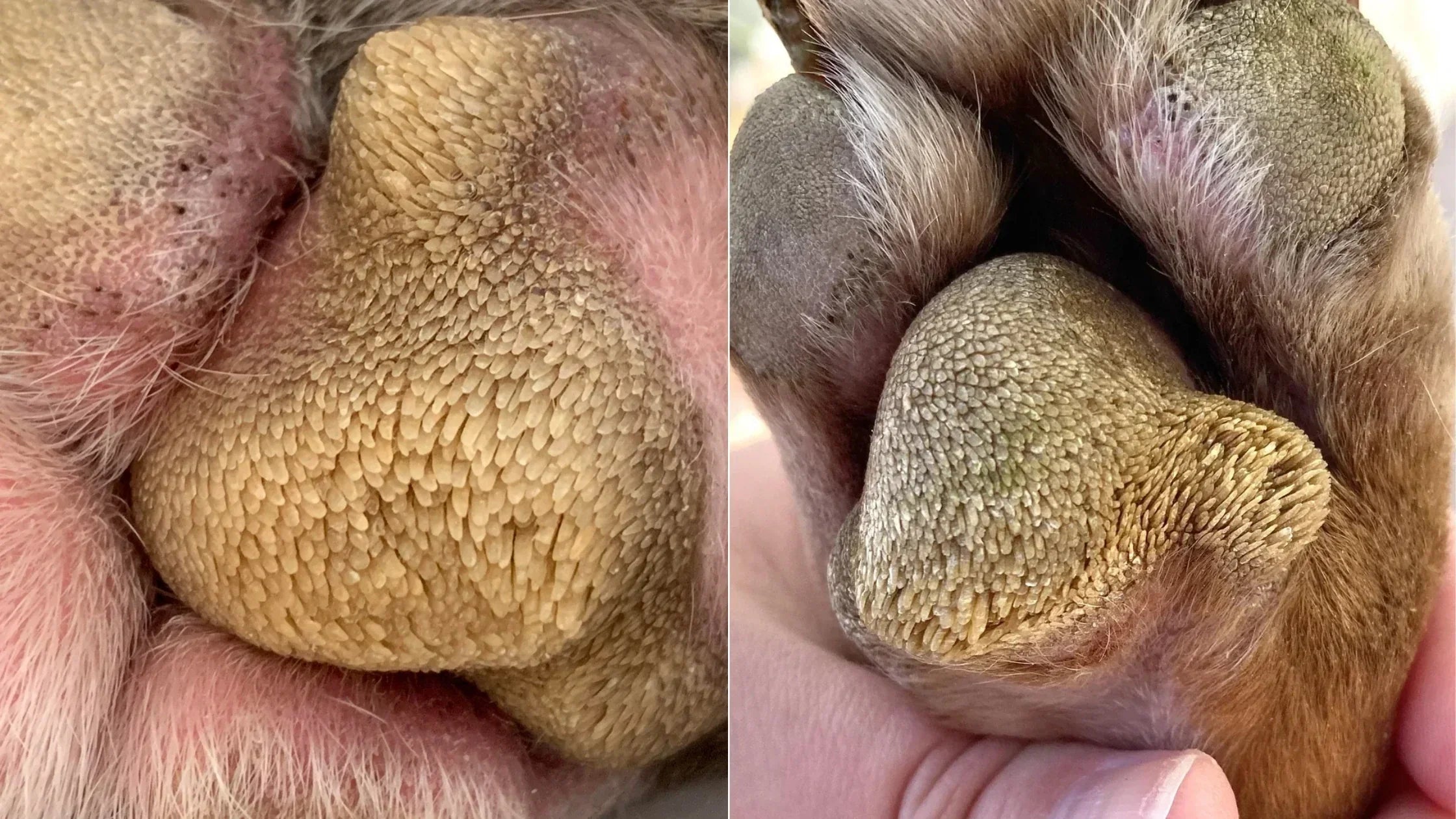
Moderate hyperkeratosis: Obvious thickening with visible raised areas. The tissue starts developing vertical cracks or fissures. Some dogs at this stage show "feathering" around the paw pad edges—small projections that look like frayed fabric.
Severe hyperkeratosis: Dramatic buildup creating horn-like projections or a fuzzy, hair-like appearance. The tissue cracks deeply and bleeds. Walking becomes painful. Nose buildup can become so thick that breathing through the nostrils becomes difficult.
Hyperkeratosis is NOT the same as normal roughness from age or activity. Senior dogs naturally develop slightly thicker paw pads. Working dogs who run on abrasive surfaces develop calluses. That's normal adaptive thickening.
Hyperkeratosis is pathological thickening—the body producing excess keratin even when there's no mechanical stimulus requiring it.
The Five Main Causes of Hyperkeratosis
1. Genetic/Idiopathic Hyperkeratosis (Most Common)
Some breeds are genetically predisposed to overproduce keratin. The genetic mechanism hasn't been fully mapped, but certain breeds develop hyperkeratosis at dramatically higher rates than others.
Breeds at highest risk:
- Irish Terriers (extremely high incidence)
- Labrador Retrievers (especially golden/yellow Labs)
- Dogues de Bordeaux
- Cocker Spaniels
- Golden Retrievers
- Bedlington Terriers
- English Springer Spaniels
In these breeds, hyperkeratosis often appears between ages 5-8 years. It typically affects paw pads first, then progresses to the nose.
A reported case involved a Golden Retriever whose owner first noticed "rough paws" at age 6. Within eight months, all four paw pads and the nose developed severe hyperkeratosis. Genetic hyperkeratosis is progressive—it doesn't spontaneously resolve.
2. Zinc-Responsive Dermatosis
Zinc deficiency causes a specific type of hyperkeratosis that responds dramatically to zinc supplementation.
This occurs in two scenarios:
Dietary zinc deficiency: Rare in dogs eating commercial food, but possible with homemade diets lacking proper supplementation. Arctic and Northern breeds (Siberian Huskies, Alaskan Malamutes, Samoyeds) have higher zinc requirements and are more vulnerable.
Zinc malabsorption: The dog consumes adequate zinc but can't absorb it properly due to intestinal issues or genetic factors. Bull Terriers and Siberian Huskies have documented genetic predisposition to zinc malabsorption.
Zinc-responsive hyperkeratosis has a distinctive presentation: crusty lesions around the eyes, muzzle, and elbows in addition to paw pads and nose. If this pattern appears, blood zinc levels should be tested.
A documented Siberian Husky case showed severe nose and paw pad involvement. Blood work revealed serum zinc at 0.4 ppm (normal is 1.0-3.0 ppm). After six weeks of zinc sulfate supplementation, the hyperkeratosis resolved almost completely.
If hyperkeratosis is zinc-related, supplementation fixes it. If it's genetic, supplementation does nothing.
3. Nasodigital Hyperkeratosis (Age-Related)
This is hyperkeratosis that develops in senior dogs with no apparent genetic predisposition or nutritional deficiency. The cause is unknown, but veterinary research suggests that declining sebaceous gland function in aging skin disrupts normal keratin shedding.
"Nasodigital" means nose and digits (paws)—the condition specifically affects these areas and spares the rest of the body.
Onset typically occurs after age 9-10 years. It develops slowly over months to years. Unlike genetic hyperkeratosis, nasodigital hyperkeratosis rarely becomes severe—it stays at mild-to-moderate levels.
Management with keratin-softening topicals usually keeps it controlled.
4. Distemper-Associated Hyperkeratosis ("Hard Pad Disease")
Canine distemper virus can cause severe hyperkeratosis of the paw pads. Historically, this was common enough to be nicknamed "hard pad disease."
This is extremely rare in modern veterinary medicine because distemper vaccination is standard. Veterinarians in areas with high vaccination rates report virtually no cases.
If your dog is vaccinated, distemper is not the cause of their hyperkeratosis.
5. Pemphigus Foliaceus (Autoimmune)
Pemphigus foliaceus is an autoimmune disease where the body's immune system attacks connections between skin cells. This can produce crusty lesions that mimic hyperkeratosis on the nose and paw pads.
Critical difference: pemphigus usually causes lesions on the face, ears, and nail beds in addition to nose and paws. Pure hyperkeratosis is limited to keratinized tissue.
Pemphigus requires immunosuppressive treatment (corticosteroids, immunomodulating drugs). Standard hyperkeratosis management won't work if the underlying cause is autoimmune.
If a veterinarian suspects pemphigus, skin biopsy is required for diagnosis.
How to Tell If Your Dog Has Hyperkeratosis vs. Normal Dryness
This is the most common question: "Is this just dryness or is it hyperkeratosis?"
Here are the distinguishing features:
Normal dryness:
- Paw pads feel rough but remain relatively flat and smooth in texture
- No visible buildup or raised projections
- Responds quickly to moisturizing (improvement in 5-7 days)
- Seasonal pattern (worse in winter or summer)
- Resolves completely with appropriate care
Hyperkeratosis:
- Paw pads develop visible thickening with distinct layers
- Raised projections, feathering at edges, or horn-like growths
- Slow response to moisturizing—or no response at all
- Progressively worsens over months if untreated
- Never resolves completely—only managed
The "fuzzy paw" appearance is diagnostic for hyperkeratosis. If your dog's paw pads look like they're growing hair-like projections, that's keratin overgrowth, not dryness.
Touch test: Run your finger across your dog's paw pad. Normal rough paws feel like sandpaper—uniform texture, slightly abrasive. Hyperkeratotic paws feel like tree bark, uneven, with ridges, cracks, and hard bumps.
If you're still unsure, take a photo and show your veterinarian. Most vets can diagnose hyperkeratosis visually.
The Two-Phase Treatment Protocol
Successful hyperkeratosis management requires understanding two distinct phases.
Phase 1: Remove the Excess Buildup (7-14 days)
You can't just apply balm over thick, crusty keratin and expect it to absorb. The excess tissue is essentially dead material that blocks product penetration.
The buildup must be softened and removed first.
Protocol:
Step 1: Soak the affected paw (or nose) in warm water for 5-10 minutes. This hydrates and softens the keratin layers. For paws, use a shallow basin. For noses, use a warm, damp washcloth held against the nose.
Step 2: After soaking, gently scrub with a soft washcloth or soft-bristle toothbrush. Don't force removal—only take off what comes away easily. If bleeding occurs, stop immediately. You've gone too deep.
The goal is gradual removal over multiple days, not aggressive scraping in one session
Step 3: Immediately after removing loose crust, apply a healing balm rich in omega-7 fatty acids. Sea buckthorn oil is the gold standard—it promotes rapid keratin regeneration and helps normalize the production/shedding cycle.
Apply liberally—you want a visible layer coating the entire affected area.
Step 4: Repeat twice daily (morning and night) for 7-14 days.
Most dogs show dramatic improvement within one week. The thick crust softens, cracks close, and new, healthier keratin emerges underneath.
A documented case involved a 6-year-old Labrador with severe paw hyperkeratosis and bleeding fissures. After 10 days of this protocol, the crust had reduced by 70% and walking returned to normal without limping.
Phase 2: Prevent Recurrence with Maintenance (Ongoing)
Here's the critical reality: hyperkeratosis is chronic. If treatment stops after the crust resolves, it will return within 4-8 weeks.
Successful management requires daily maintenance application of a balm that:
- Keeps keratin soft and pliable (prevents buildup from re-forming)
- Supports normal keratin shedding (prevents retention)
- Absorbs quickly so it doesn't feel heavy or greasy
This is where all-season formulas with fast-absorbing oils excel. Avocado oil, in particular, has a fatty acid profile that maintains keratin flexibility without creating heavy buildup.
Apply once daily to affected areas after the acute buildup has been removed. Most dogs can maintain normal-looking paw pads and noses indefinitely with 30 seconds of daily application.
If maintenance is skipped, the hyperkeratosis returns. Veterinarians report this pattern repeatedly with clients who stop after initial improvement. Consistency is everything.
Why Heavy Waxes Make Hyperkeratosis Worse
A common mistake deserves attention: using thick, wax-heavy balms for hyperkeratosis management.
Products designed for extreme winter protection typically contain high concentrations of beeswax, carnauba wax, or candelilla wax. These create thick protective barriers—which is exactly what's needed for salt and ice protection.
But for hyperkeratosis, heavy waxes are counterproductive.
Here's why: hyperkeratosis is already a buildup problem. The tissue is retaining keratin that should be shedding. Adding a thick wax layer on top traps even more dead keratin against the surface.
The wax creates an occlusive seal that prevents natural shedding. Instead of helping, the buildup worsens.
Additionally, wax-heavy formulas don't penetrate. They sit on the surface. Hyperkeratotic tissue needs deep moisturization to soften the keratin layers—surface coating doesn't achieve that.
One documented case involved a dog owner using a "mushing wax" product on hyperkeratotic paws for months. The condition progressively worsened because the wax created a barrier that trapped dead keratin and prevented beneficial ingredients from reaching the tissue.
After switching to an avocado-based formula that absorbs within 2-3 minutes, the hyperkeratosis improved dramatically within two weeks.
For hyperkeratosis management, absorption speed matters more than barrier strength.
Breed-Specific Considerations
Certain breeds require modified protocols:
Irish Terriers often develop severe, fast-progressing hyperkeratosis. These dogs may need twice-daily maintenance even after the initial buildup is removed. Some Irish Terriers require lifelong twice-daily application to keep the condition controlled.
Labrador Retrievers typically develop moderate hyperkeratosis that responds well to standard protocols. However, Labs often have concurrent allergy issues that make them lick their paws obsessively—which prevents balm absorption. For Labs, application timing is critical—apply after walks when they're tired and less likely to lick.
Cocker Spaniels frequently have both hyperkeratosis and seborrhea (excess oil production). This combination creates greasy, crusty buildup. Cockers need more frequent soaking and gentle exfoliation (2-3 times weekly) to prevent buildup from becoming severe.
Arctic breeds (Huskies, Malamutes) with hyperkeratosis should always be tested for zinc deficiency before assuming it's genetic. These breeds have higher zinc requirements and malabsorption is relatively common.
Dogues de Bordeaux and other giant breeds with heavy body weight experience more mechanical stress on hyperkeratotic paws. The thick pads crack more easily under pressure. These dogs benefit from protective boots during extended walks in addition to daily balm application.
When Hyperkeratosis Requires Veterinary Intervention
Most cases can be managed at home with proper soaking, gentle exfoliation, and daily maintenance balm.
However, some situations require veterinary care:
Deep cracks with active bleeding: If the fissures are bleeding and won't stop with gentle pressure, the tissue may be infected or the cracks extend into the dermis (deeper skin layer). Veterinarians may prescribe topical antibiotics.
Severe pain or limping: If the dog refuses to walk, holds paws up constantly, or shows signs of pain when the affected area is touched, the hyperkeratosis has caused significant tissue damage. Pain management and more aggressive treatment may be needed.
Rapid progression: If hyperkeratosis develops suddenly over 2-4 weeks rather than months, or if it's accompanied by other symptoms (lethargy, skin lesions elsewhere, facial swelling), this could indicate an underlying systemic disease rather than simple hyperkeratosis.
No improvement after 14 days of proper treatment: If the soak-exfoliate-heal protocol twice daily for two weeks shows no improvement, the diagnosis may be wrong or there's a concurrent condition (pemphigus, zinc deficiency, fungal infection) that requires medical treatment.
Breathing difficulty: If nose hyperkeratosis is so severe that nostrils are partially blocked, this requires immediate veterinary attention. Severe nasal hyperkeratosis can be surgically trimmed under sedation if it's compromising breathing.
The Long-Term Reality of Living with Hyperkeratosis
Veterinarians consistently emphasize this message: "Hyperkeratosis is chronic. It won't go away. But it can be managed so effectively that most people won't even notice your dog has it."
Hyperkeratosis management is a lifestyle, not a treatment course.
The good news: once you establish a routine, it takes 30-60 seconds per day. Most dogs tolerate paw and nose balm application well—especially if the routine starts when the condition is mild rather than waiting until it's severe.
The routine that works:
Week 1-2: Aggressive buildup removal (soak, exfoliate, heal—twice daily)
Week 3-4: Transition to once-daily maintenance as buildup resolves
Week 5+: Continue daily maintenance indefinitely
Most owners integrate this into their nighttime routine—apply balm after the evening walk, before bed. Dogs associate it with winding down for the day, which makes application easier.
Some owners batch-prepare warm water soaks and keep the basin near the door for quick paw maintenance after winter walks.
Others apply during TV time—dog sitting next to them on the couch, getting paw balm during commercials.
The key is consistency without obsession. Missing a day occasionally isn't critical. But missing 3-4 days regularly will result in buildup returning.
Why Year-Round Maintenance Beats Seasonal Treatment
Many dog owners only treat hyperkeratosis in winter—because winter salt and cold make the cracking more obvious and painful.
This approach is backwards.
Hyperkeratosis is a year-round condition. The excess keratin production doesn't stop in summer. What changes in winter is the mechanical stress—salt, ice, and temperature extremes cause the thickened tissue to crack more severely.
If treatment only occurs in winter, severe buildup develops each year. That means 2-3 weeks of intensive removal protocol every fall.
If maintenance continues year-round, the buildup never develops. Severe cracking is prevented before it happens. And winter walks become dramatically less painful.
Veterinarians compare it to dental care: you don't only brush teeth when cavities appear. You brush daily to prevent cavities from forming.
Same principle with hyperkeratosis. Daily maintenance prevents the severe buildup that causes pain, bleeding, and infection.
Summer is actually the ideal time to establish control because there's less mechanical stress. The tissue heals faster. By the time winter arrives, healthy paw pads have been maintained for months and they're far more resilient to salt and cold.
Managing Hyperkeratosis: The Complete Approach
Hyperkeratosis is chronic, progressive, and incurable—but highly manageable with the right approach.
Phase 1: Remove existing buildup with warm water soaks, gentle exfoliation, and healing balm rich in omega-7 fatty acids. Seephy's Sea Buckthorn Healing Balm delivers the regenerative fatty acids needed for this acute phase. Apply twice daily for 7-14 days until crust softens and cracks close.
Phase 2: Prevent recurrence with daily maintenance using a fast-absorbing, keratin-softening formula. Seephy's Avocado All-Season Shield uses avocado oil that penetrates hyperkeratotic tissue effectively without creating heavy buildup. Apply once daily indefinitely.
The protocol is simple:
- Soak in warm water 5 minutes (2-3x weekly during maintenance)
- Gently remove any loose crust
- Apply balm to clean, slightly damp tissue
- Repeat daily
Most dogs show dramatic improvement within 10-14 days and maintain normal-looking paws and nose with consistent daily application.
Dogs with hyperkeratosis don't have to live with painful, cracked, bleeding paw pads. One minute per day prevents months of discomfort.