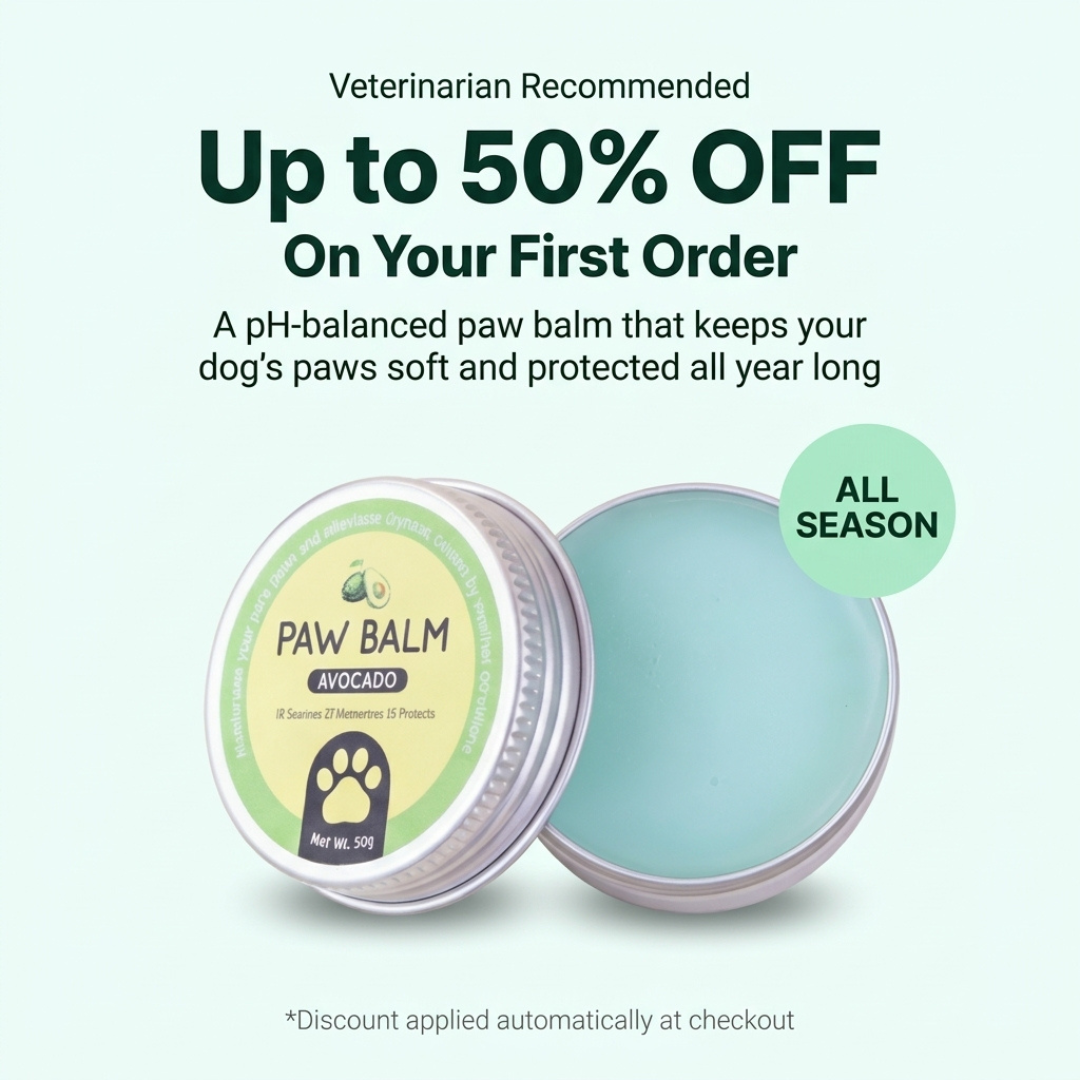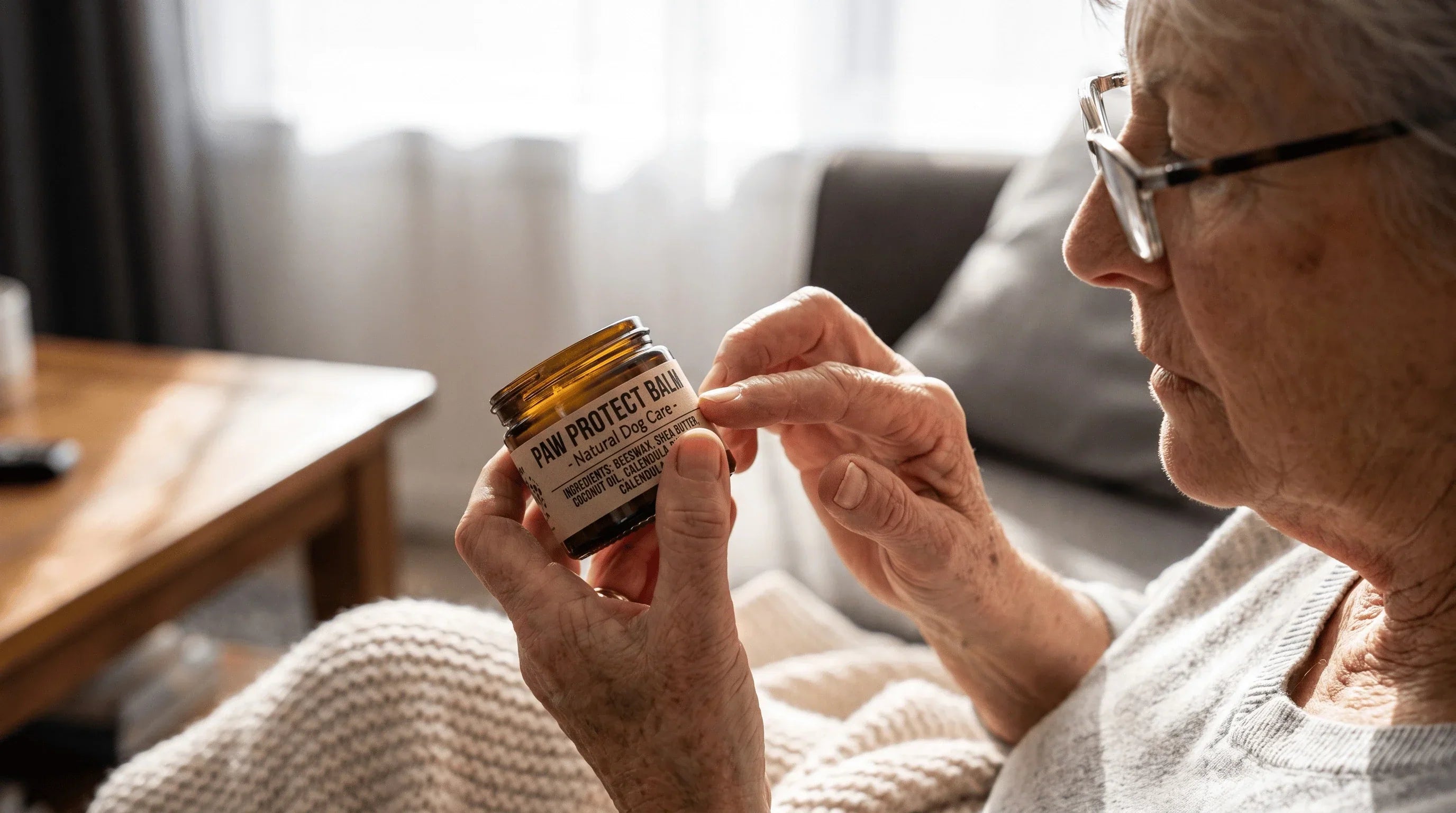
Most dog paw balms are basically the same product in different jars.
Petroleum jelly, beeswax, coconut oil. Maybe some vitamin E for marketing. A drop of essential oil to make it smell "natural." Different packaging, different prices, same basic formula.
In my Minneapolis practice, I see this every week. An owner comes in frustrated because their dog's cracked paws haven't improved after three months of applying the "top-rated paw balm" from the pet store. They show me the jar. I read the ingredients. And I have to explain that the product they've been faithfully applying has almost no active ingredients that address the underlying tissue issue.
This isn't a scam. It's just the reality of how most commercial paw balms are formulated.
Cheap ingredients that feel greasy on skin. Marketing that emphasizes "natural" and "organic" without explaining what those words actually mean at the cellular level. Reviews from owners who don't know the difference between temporary surface moisture and actual barrier support.
If you've ever wondered why some paw balms work and others don't—despite similar prices and marketing, this article is your decoder ring.
I'll walk through the ingredients that actually matter, what they do biologically, what to avoid, and how to read a paw balm label like a veterinarian would.
By the end, you'll know exactly what to look for and what's not worth your money.
The Fundamental Problem With Most Paw Balms
Before we get into individual ingredients, understand this: paw skin is different from human skin.
- pH: Dog skin is 6.5-7.2 (near neutral). Human skin is 4.5-5.5 (acidic).
- Layer structure: Dogs have fewer stratum corneum layers (3-5 vs human 15-20)
- Barrier function: Dogs have less ceramide and different lipid composition
- Regeneration: Different cellular turnover patterns
- Function: Paw pads bear weight, exposure to elements, thermoregulation
This means human skincare logic doesn't automatically transfer. A product that works beautifully on human hands may do nothing or actively harm dog paw skin.
Most commercial paw balms make one of three mistakes:
1. They're just repackaged human moisturizers. Ingredients formulated for acidic human skin, applied to near-neutral dog skin. The pH mismatch disrupts the skin barrier rather than supporting it.
2. They're waxy surface coatings with no active ingredients. Petroleum jelly, beeswax, mineral oil, these create a physical barrier on top of skin but don't penetrate or support cellular processes underneath.
3. They're loaded with "natural" ingredients that sound impressive but do nothing. Essential oils, exotic butters, fashionable botanical extracts, chosen for label appeal rather than functional evidence.
Effective paw balms address three specific needs: barrier protection, cellular support, and healing capacity. Ingredients matter because different ingredients address different needs.
Let me walk you through what actually works.
The Ingredients That Actually Work
Here are the paw balm ingredients backed by evidence and clinical results—what they do, why they matter, and what to look for on labels.
1. Sea Buckthorn Oil (Hippophae rhamnoides)
What it is: Oil extracted from the berries and seeds of the sea buckthorn plant, a hardy shrub native to Europe and Asia.
Why it matters: Sea buckthorn is one of the few plant oils rich in omega-7 palmitoleic acid, a fatty acid that specifically modulates keratin synthesis at the cellular level.
What this means practically:
- Supports keratin regulation (crucial for hyperkeratosis)
- Enhances skin barrier repair
- Anti-inflammatory properties for irritated tissue
- Rich in vitamins A, C, E, and K
- Contains rare palmitoleic and myristoleic fatty acids
Where you'll see clinical impact: Healing damaged pads, treating hyperkeratosis, supporting compromised skin barriers, post-injury recovery.
Why most competitors don't use it: Sea buckthorn oil is dramatically more expensive than coconut oil or petroleum. It's a premium ingredient reserved for formulas designed for actual healing rather than mass-market appeal.
On a label: Look for "sea buckthorn oil," "Hippophae rhamnoides seed oil," or "Hippophae rhamnoides fruit oil."
2. Avocado Butter
What it is: Solid fat rendered from avocado pulp, not to be confused with avocado oil (which is liquid and less potent).
Why it matters: Avocado butter has an unusual fatty acid profile that closely matches the natural lipids in dog skin.
What this means practically:
- Deep tissue penetration (unlike surface-only waxes)
- Supports the skin's natural lipid layer
- Rich in vitamins A, D, E, and B
- Non-greasy after absorption
- Excellent for year-round daily use
Where you'll see clinical impact: Everyday paw maintenance, prevention of dryness, supporting skin barrier for allergic dogs, year-round protection.
Why most competitors don't use it: Avocado butter costs 6-8x more than coconut oil per weight. It also requires more sophisticated formulation, it doesn't just "melt into" waxy blends easily.
On a label: "Avocado butter" or "Persea gratiensis butter."
3. Shea Butter
What it is: Solid fat extracted from the nuts of the shea tree, native to West Africa.
Why it matters: Shea butter is unusually rich in unsaponifiable compounds, the "leftover" fatty acids that resist saponification and provide long-lasting barrier support.
What this means practically:
- Powerful cold-weather barrier (freezing temperatures)
- Prevents moisture loss in extreme conditions
- Anti-inflammatory triterpenes
- Rich in vitamins A and E
- Slow-melting for extended protection
Where you'll see clinical impact: Winter protection against cold and salt, extreme weather resistance, dogs walking on ice-melt chemicals.
Why most competitors use inferior alternatives: Genuine shea butter is expensive. Many "shea butter" products contain heavily refined shea (which has lost most of its active compounds) or shea blended down with cheaper waxes.
On a label: Look for "unrefined shea butter" or "raw shea butter." "Refined shea" has lost much of its functional value.
4. Coco Butter (Theobroma Cacao)
What it is: Solid fat pressed from cocoa beans, yes, the same source as chocolate.
Why it matters: Coco butter has a unique melting point (around 93°F/34°C) that makes it especially effective in hot weather, it stays firm at room temperature but melts on contact with warm paw skin, delivering active compounds directly to tissue.
What this means practically:
- Ideal summer heat protection
- Antioxidant polyphenols
- High vitamin E content
- Long shelf-life without preservatives
- Non-comedogenic for skin
Where you'll see clinical impact: Hot pavement protection, summer paw care, warm-weather barrier support.
Why most competitors don't use it: Coco butter is expensive and requires temperature-controlled storage. Many "coco butter" products actually use hydrogenated palm oil disguised as coco butter.
On a label: "Coco butter," "Theobroma cacao seed butter," or "cocoa butter."
5. Vitamin E (Tocopherol)
What it is: Fat-soluble antioxidant vitamin.
Why it matters: Vitamin E protects other ingredients from oxidation (extending product life) AND provides direct skin benefits when applied topically.
What this means practically:
- Natural preservative (allows fewer artificial preservatives)
- Antioxidant protection for skin cells
- Supports healing
- Enhances absorption of other active ingredients
Where you'll see clinical impact: Product stability, skin cell protection, supporting overall formula efficacy.
Concern: Not all "vitamin E" is equal. Natural tocopherol (d-alpha) is significantly more bioavailable than synthetic (dl-alpha). Cheap products use synthetic; quality products use natural.
On a label: "Tocopherol," "d-alpha tocopherol" (best), or "Vitamin E."
6. pH Buffering (Not an Ingredient, But Critical)
What it is: Formulation technology that ensures the product's pH matches dog skin (6.5-7.2), not human skin.
Why it matters: Applying an acidic product (pH 4.5-5.5) to neutral dog skin disrupts the skin barrier and creates conditions favorable for bacterial and yeast overgrowth.
What this means practically:
- Products designed for dog skin at cellular level
- Preserves natural skin barrier function
- Reduces risk of secondary infections
- Compatible with allergic and sensitive skin
Where you'll see clinical impact: Dogs with recurrent skin infections, allergic dogs, dogs with compromised skin barrier.
Why most competitors ignore this: pH buffering is invisible on the label. You can't market it visually. But it makes a fundamental difference in whether a product supports or damages dog skin.
On a label: Look for "pH-buffered" or "pH-matched for canine skin." Products that specify their pH (6.5-7.2 range) are formulated correctly.
The Ingredients to Avoid
Now the opposite side: what NOT to want in a dog paw balm.
1. Petroleum Jelly / Petrolatum
What it is: Byproduct of oil refining, a semisolid mixture of hydrocarbons.
Why to avoid:
- Surface-only coating, doesn't penetrate or nourish tissue
- Traps bacteria against skin (potential infection risk)
- Prevents skin from breathing normally
- No active biological benefit whatsoever
- Not safe if licked in significant quantities (which dogs will do)
On a label: "Petrolatum," "petroleum jelly," "Vaseline," "mineral oil."
Why so many balms use it: It's extraordinarily cheap, has infinite shelf life, and feels moisturizing to the touch. All perception, no substance.
2. Essential Oils (Tea Tree, Eucalyptus, Peppermint, etc.)
What they are: Concentrated aromatic compounds from plants.
Why to avoid:
- Many are toxic to dogs if ingested (and dogs WILL lick paw balms)
- Cause skin irritation especially on compromised barriers
- Overwhelm sensitive dog scent receptors (dogs have 40x more scent cells)
- Unnecessary for efficacy — marketing appeal over function
- Particularly dangerous: tea tree oil, wintergreen, pennyroyal, pine oil
On a label: Watch for "essential oils," "tea tree extract," "menthol," "eucalyptus," "lavender oil," or "aromatic blend."
The exception: Some plant-derived compounds like vitamin E-rich oils are fine. The problem is concentrated essential oils used for scent, not function.
3. Alcohol-Based Ingredients
What they are: Denatured alcohols, propylene glycol in high concentrations.
Why to avoid:
- Dry out skin rather than moisturize
- Damage compromised skin barrier
- Irritating on wounds or hyperkeratotic tissue
- Toxic if licked in significant quantities
On a label: "Alcohol denat," "ethanol," "isopropyl alcohol," "SD alcohol."
Common location: "Refreshing" or "cooling" paw balms often use alcohol for the sensation. The sensation is skin damage happening.
4. Artificial Fragrances and Colors
What they are: Synthetic compounds added for scent or visual appeal.
Why to avoid:
- Irritation risk especially for allergic dogs
- No functional benefit
- Multiple compounds hidden under "fragrance" (can be dozens)
- Sensitive dogs react dramatically to synthetic scents
On a label: "Fragrance," "parfum," "artificial color," "FD&C dyes."
The rule: If it smells strongly synthetic, it's not for your dog.
5. Parabens and Formaldehyde-Releasing Preservatives
What they are: Synthetic preservatives extending product shelf life.
Why to avoid:
- Endocrine disruption concerns (particularly for parabens)
- Skin sensitivity risks
- Alternatives exist (vitamin E-based preservation)
- Not necessary in properly formulated products
On a label: "Methylparaben," "propylparaben," "butylparaben," "DMDM hydantoin," "quaternium-15," "imidazolidinyl urea."
6. Coconut Oil (as the Only Active Ingredient)
Wait, coconut oil? Really?
Yes. Coconut oil isn't harmful. It's just dramatically overrated as a paw balm ingredient.
Why it's problematic as the primary active:
- Melts at 76°F (24°C)—means it liquefies during summer, offers no protection
- Doesn't penetrate keratinized tissue effectively
- Creates surface coating rather than cellular support
- Doesn't address hyperkeratosis at the cellular level
- Widely believed to be more effective than it is (marketing over evidence)
On a label: "Coconut oil" or "Cocos nucifera oil."
When coconut oil is fine: As a minor ingredient in a well-formulated product. The problem is when it's the primary active ingredient—which is common in cheap "natural" balms.
How to Read a Paw Balm Label Like a Veterinarian
Now let's put this together. Here's my ingredient audit protocol when I'm evaluating a paw balm for a patient.
Step 1: Check the first three ingredients.
Ingredients are listed by concentration. The first three ingredients constitute the majority of the product. If they're all cheap waxes and oils (petroleum, coconut oil, beeswax), the "active" ingredients later in the list are present in negligible quantities.
Good first three: Shea butter, avocado butter, sea buckthorn oil
Concerning first three: Petroleum, beeswax, coconut oil
Step 2: Look for the active ingredients.
Sea buckthorn oil, avocado butter, shea butter, coco butter, vitamin E, pH-buffering. These should appear in the top 5-7 ingredients if they're at meaningful concentrations.
Red flag: Marketing claims about "sea buckthorn benefits" when sea buckthorn is the 15th ingredient (meaning trace amounts).
Step 3: Scan for red flags.
Essential oils, artificial fragrances, alcohol, petroleum products, parabens. Any of these disqualify a product for me unless there's exceptional justification elsewhere in the formula.
Step 4: Verify pH claims.
Products that mention pH should specify the range (6.5-7.2 for dog skin). Products that don't mention pH at all are typically not formulated with dog skin biology in mind.
Step 5: Consider the price point.
This isn't about being expensive equals better. But formulations with sea buckthorn oil, shea butter, avocado butter, and vitamin E at meaningful concentrations have a real cost floor. A $6 paw balm cannot contain meaningful amounts of these ingredients, the ingredient cost alone exceeds the retail price.
Realistic price ranges:
- Sub-$10 balm: Cheap ingredients, basic formulation. May work for occasional dry paws but limited healing capacity.
- $10-20 balm: Better ingredients possible but formulation quality varies widely. Read labels carefully.
- $20-35 balm: This is the range where meaningful active ingredients can be present at effective concentrations.
- $35+ balm: Should offer premium ingredients AND premium formulation. Verify with labels.
The Ingredient Truth About "All-Natural" Balms
The word "natural" on a paw balm label means almost nothing.
Petroleum jelly is technically "natural" (it's derived from petroleum). Coconut oil is natural but ineffective as primary active. Essential oils are natural but potentially toxic to dogs.
"Natural" is a marketing word, not an ingredient quality indicator.
What matters is:
- Are the active ingredients evidence-supported for canine skin?
- Are they at effective concentrations?
- Is the formulation pH-appropriate for dog skin?
- Are irritating or toxic ingredients avoided?
- Is the product safe if licked?
A synthetic product formulated correctly is better than a "natural" product formulated poorly. A "natural" product with sea buckthorn, avocado butter, and pH buffering is ideal.
Regional and Seasonal Considerations
Different climates call for different ingredient priorities:
🌡️ Hot climates or summer:
- Coco butter is superior (melts at 93°F)
- Coconut oil is inadequate (melts at 76°F, liquefies)
- Avocado butter works year-round
❄️ Cold climates or winter:
- Shea butter provides best cold-weather barrier
- Sea buckthorn oil supports healing of salt/cold damage
- Avocado butter still works but pair with shea
🏔️ Extreme conditions (mountain, arctic):
- Look for combined shea + coco butter formulations
- pH buffering becomes even more critical
- Sea buckthorn for damaged tissue
🌍 Temperate/year-round:
- Avocado butter as base provides consistent performance
- pH-buffered formulation
- Add sea buckthorn for any existing issues
When Ingredient Choice Really Matters
Some situations demand ingredient scrutiny more than others.
Higher stakes = higher scrutiny required:
🩺 Dogs with allergies: Avoid essential oils, fragrances, potential irritants. pH buffering essential.
🐕 Senior dogs: Gentle ingredients, no alcohol, no essential oils. Sea buckthorn for compromised healing.
🩹 Dogs with hyperkeratosis: Sea buckthorn is non-negotiable. Avoid pure surface waxes.
🌡️ Dogs in extreme climates: Match ingredient melting points to conditions.
🤢 Sensitive stomach dogs: Ensure ALL ingredients are safe if licked in significant quantities.
Lower stakes = more flexibility:
🐕 Healthy adult dogs, mild climate, occasional application: More forgiveness on formula. But even here, avoid petroleum and essential oils.
The Bottom Line
Most dog paw balms on the market are functionally similar, cheap, surface-only, minimal biological activity.
The few that actually work share specific ingredient patterns:
Should be present:
- Sea buckthorn oil (for healing)
- Quality butter base (shea, avocado, or coco depending on climate)
- Vitamin E (for antioxidant support)
- pH-buffered formulation
Should be absent:
- Petroleum jelly as primary ingredient
- Essential oils
- Alcohol
- Artificial fragrances and colors
- Parabens
The ingredient list tells you more than the marketing.
A well-formulated paw balm is not cheap to produce. If you find one at a bargain price, either the ingredients are cheap alternatives or the active ingredients are present in trace amounts.
The good news: Once you know what to look for, you can evaluate any product on the shelf in 30 seconds. You'll no longer be fooled by marketing that emphasizes "natural" and "vet-approved" without substance.
Your dog's paws deserve ingredients that actually work at the cellular level. That means avoiding the petroleum-and-coconut-oil pattern of cheap balms and choosing formulations with real active compounds at meaningful concentrations.
Read the label. Trust the ingredients. Your dog will feel the difference.