Written by Dr. Marcus Chen, DVM
Every year, as soon as the weather turns cold, my Minneapolis practice fills up with the same appointment.
An owner brings in an older dog, usually one of the big breeds, a Lab, a Golden, a German Shepherd, with the same story. "He was fine all summer. Now that it's getting cold, he's stiff and favoring a back paw. His arthritis must be coming back."
Sometimes they're right. Arthritis is real, it's common in senior dogs, and cold weather genuinely makes it worse.
But after years of these appointments, I've learned that in a large share of these dogs, arthritis isn't the whole story, and sometimes it isn't the main story at all. Part of what the owner is watching is coming from somewhere they've never thought to check: the paw pads.
And the first cold weeks of fall are exactly when the two problems start hiding behind each other.
Here's what's actually happening:
- Cold weather stiffens arthritic joints, the limp everyone expects
- Cold, dry air and harder ground thicken and crack paw pads, a limp nobody looks for
- Both produce the same symptom: a stiff, reluctant, slightly limping senior dog
- Damage that built up over summer finally becomes visible now
- The paw-pad component is often the more treatable of the two, and the one that gets missed
- Early cold is the last easy window to fix it before deep winter makes everything harder
This guide walks through why cold weather blurs the line between arthritis and paw pain, how to tell what you're actually dealing with, and what to do about it, starting now.
Why Cold Weather Blurs Arthritis and Paw Pain
Early fall doesn't feel like a paw emergency. The weather's still mild most days, there's no hot pavement or ice yet. So when a senior dog starts limping, "arthritis" is the natural assumption, and it's usually only half-checked.
Here's why the two conditions become so easy to confuse once it turns cold:
1. Cold stiffens joints. Falling temperatures reduce circulation to the limbs and thicken joint fluid. A dog with existing arthritis moves more carefully, rises more slowly, and warms up gradually on walks. Classic, and real.
2. Cold, dry air hardens paw pads. As outdoor air dries out and indoor heating kicks in, and as your dog walks on colder, harder ground, the pads lose moisture and thicken. In seniors this happens faster, because aging skin already overproduces keratin, the tough protein in the outer pad.
3. A dog in pad discomfort adjusts instead of yelping. It shifts weight off the paw, hesitates on cold surfaces, takes a beat longer to stand, which is exactly what an arthritic dog looks like.
4. Summer damage surfaces now. Micro-cracks, chronic dryness, and hyperkeratosis progression that built up in July and August often don't become obvious until the first cold weeks of fall.
5. Both worsen at the same time. Cold reduces circulation to the joints and to the peripheral pad tissue at once, so arthritis and pad hardening flare together, reinforcing the "it's just the arthritis" conclusion.
6. The exam usually stops at the joints. The vet checks the joints, finds age-appropriate arthritic changes (present in nearly every senior dog), confirms "some arthritis," and the conversation moves on. The pads never get turned over and felt.
This compound picture is why paw care for a senior dog has to be deliberate once the cold sets in. If you only treat the arthritis, you leave half the limp untreated all winter.
What Changes When the Cold Sets In
Here are the specific shifts to watch for, and what to do about each.
Shift 1: Cold Reawakens the Arthritis Signal
The first cold mornings bring back the stiffness owners remember. Worst right after waking, easing as the dog moves and warms up, the hallmark of joint pain.
What to do:
- Keep the joints moving with gentle, regular, shorter walks rather than one long outing
- Give the dog a warm, cushioned place to sleep, away from drafts and cold floors
- Ask your vet about weight, pain management, and mobility support. Arthritis deserves proper management in its own right
- Don't stop here, though: a stiff senior dog needs its paws checked too
Related: What changes in senior dog paw care after age 7
Shift 2: Dry Air and Hard Ground Thicken the Pads
This is the hidden half of the limp. Falling humidity, indoor heating, and colder, harder walking surfaces pull moisture out of the pads. The tissue thickens and stiffens, the edges harden, and small cracks begin, especially in senior dogs already prone to keratin buildup.
What to do:
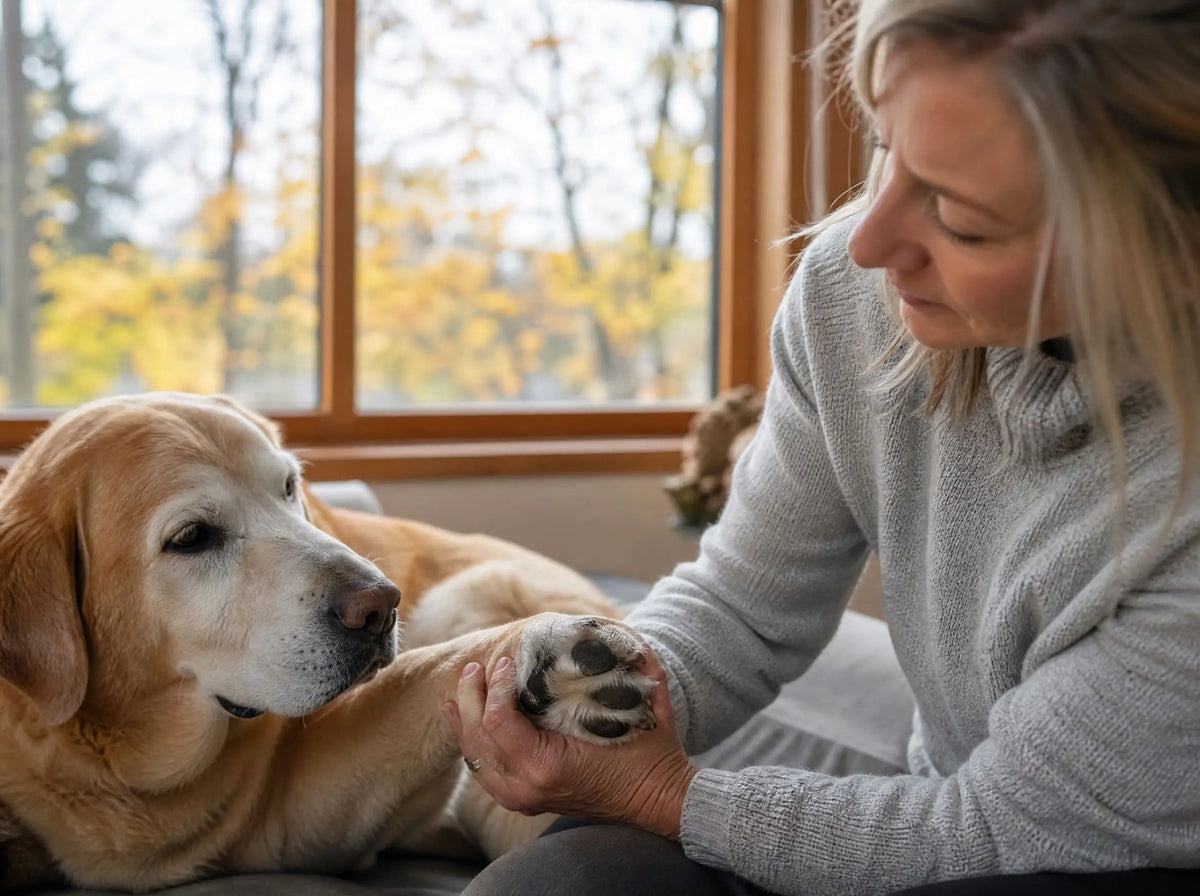
- Turn each paw over and feel the pads by hand, weekly. Don't rely on how the dog is walking
- Warm-soak any thickening pad for 5 to 10 minutes, then apply a healing balm while the tissue is soft
- Address early roughness now, before it becomes cracking that winter salt and ice will attack
Related: The 5 causes of paw pad peeling and how to identify each
Shift 3: The Two Symptoms Look Identical
A dog favoring a back paw because a joint aches and a dog favoring a back paw because the pad is hard and cracked walk almost the same way. Owners, and busy exams, default to the diagnosis they already have a name for.
What to do:
- Run the two-minute check in the next section, so you're working from what you actually felt, not from an assumption
- If you find both stiff joints and hardened pads, treat both. That's the most common senior scenario and where owners see the biggest improvement
- Bring your findings to your vet. "The pad edges feel hard and cracked" changes what they look at
Shift 4: Summer Pad Damage Becomes Visible
Hot-pavement wear, chronic summer dryness, and hyperkeratosis that progressed over the warm months frequently show up "suddenly" once it cools off: peeling, roughness, brittle nails. It wasn't sudden; it was accumulating.
What to do:
- Do a full assessment in good light: examine each pad, check between the toes, compare left to right
- Treat existing damage with a sea buckthorn healing balm now. Cold weather intensifies any pad problem dramatically
- Photograph the pads so you can track whether they're improving or worsening week to week
Related: The step-by-step hyperkeratosis treatment protocol
How to Tell Them Apart: The Two-Minute Check
You don't diagnose this yourself, that's your vet's job, but you can gather the information that points everyone in the right direction. You do it with your hands.
Check the joints first. Gently flex the back legs and hips. A dog with joint pain often tenses, resists, or pulls away when a specific joint is moved. Stiffness that's worst first thing in the morning and eases as the dog warms up is a strong arthritis signal.
Then, the step almost everyone skips, turn the paw over and feel the pads. Run your thumb across each pad and around the edges of the toe pads specifically. Watch for:
- Sharp, rough, or firm edges compared to the softer center of the pad, the earliest sign, and the one owners say they'd felt for months without knowing it mattered
- A thickened, stiff pad that feels like hardened rubber instead of pliable tissue
- Fine cracks, flaking, or a dry crusty texture, usually at the edges first
- A reaction, a flinch or pull-back, when you press a specific spot, or more licking of that paw afterward
Reading the result:
- Stiff joints plus hardened pads: very likely both problems. Treat both.
- Joints fine, pads rough and thick: the "arthritis" may be largely a paw problem in disguise.
- Sudden, severe, or non-weight-bearing limp: skip the home check and see your vet now.
What Actually Softens a Hardened Senior Pad
If you've read anything about dry paws, you've been pointed to coconut oil, petroleum jelly, or a general balm. On a senior dog's thickened pads, these mostly disappoint, and it's worth knowing why before you spend a whole season on the wrong thing.
A hardened pad isn't just dry on the surface. The problem sits in the deeper layer, where too much keratin is being produced and the tissue is thickening from below. A product that only coats the surface makes the pad shiny for a few hours, then it's right back to baseline. The surface was never the issue.
To soften that tissue, you need an ingredient that penetrates the pad and works on the keratin itself. The one I reach for is sea buckthorn oil, exceptionally high in omega-7 (palmitoleic acid), a fatty acid that absorbs into the deeper pad tissue and supports healthy keratin turnover and skin repair from within, rather than sitting on top. On a thickened senior pad, that's the difference between a temporary shine and tissue that's genuinely more pliable a few weeks later.
A few things that matter most for senior dogs:
- Warm-soak before you apply. Warm (not hot) water makes the hard pad pliable so the oil can actually penetrate. Skipping this is the number-one reason balm "doesn't work."
- Be consistent. Softening thickened tissue takes weeks of daily application, not one treatment. In an older dog, expect gradual change: real, but not overnight.
- Use a formula that's safe if licked. Seniors lick their paws too. Anything on a pad must be non-toxic and free of essential oils, which can irritate or worse.
- Keep checking weekly. Once you know what early roughness feels like, you'll catch it next time before it cracks.
None of this competes with arthritis treatment. You do both. You're managing the joints and removing the paw-pad layer of discomfort that the joints were getting blamed for.
The Fall-to-Winter Routine for Senior Paws
Here's the month-by-month routine I recommend in practice for an older dog:
🌾 September (early fall):
- Do a full paw assessment: examine each pad for lingering summer damage
- Start the weekly hands-on check (joints and pads)
- Treat any existing roughness or cracking with healing balm now
- Watch for the first cold-morning stiffness returning
🍂 October (peak transition):
- Warm-soak and apply balm to any thickening pad, twice daily during cold snaps
- Keep the joints moving: short, frequent walks over one long one
- Photograph the pads to track progression
- Begin thinking about winter protection before the salt and ice arrive
❄️ November (pre-winter):
- Have healthy, pliable pads before deep-winter conditions hit
- Move into full seasonal protection for the cold months
- Book a vet check for chronic conditions (arthritis and hyperkeratosis both) before the cold intensifies them
When to See Your Vet
This article is about a component of senior limping that gets missed, not a reason to skip the vet. See your veterinarian if:
🚨 The limp is sudden, severe, or the dog won't bear weight on a leg at all
🚨 A pad is cracked and bleeding, or there's swelling, heat, or a bad smell, possible infection
🚨 Joint pain and stiffness are clearly present. Arthritis needs proper management, and the paw routine is an addition, not a replacement
🚨 Hyperkeratosis appears suddenly or on several areas (pads and nose, or multiple sites), which can signal an underlying condition
🚨 You see no improvement after several weeks of consistent, correct paw care. Time to reassess the diagnosis
The Core Principles
Whatever your dog's specific situation, these hold:
- Turn the paw over. Don't let "it's just arthritis" close the conversation before anyone has looked at the pads.
- Assume it can be both. In senior dogs, once it turns cold, joint pain and pad pain usually travel together. Treating one and ignoring the other leaves half the limp in place.
- Consistency beats intensity. Daily warm-soak-and-balm on a thickening pad does more than an occasional heavy treatment.
- Early cold is the last easy window. Softening pads is far easier now than on cracked, salt-exposed tissue in January.
- Match the product to the pad. Thickened, cracking pads need repair now; healthy pads need protection as deep winter approaches.

A Realistic Outlook
You can't reverse arthritis, and I won't pretend a balm will. What you can do is take away the second source of your senior dog's limp, the one nobody looked for, and send it into winter with pads that are soft, intact, and ready for the hardest months of the year.
Because a senior dog's needs shift as the season turns, repair now, protection as the cold and salt arrive, one product rarely covers the whole picture. That's why we built The Complete Shield System: the sea buckthorn healing balm for the thickened, cracking pads you're dealing with as it turns cold, and the seasonal shields to protect those pads once winter sets in. Safe if licked, formulated for exactly the aging, hard-worked paws that carry a big senior dog through the years.
Your old dog has earned an easier walk. This season, before you write the limp off as one more thing about getting old, turn the paw over and look. The answer is often right there in your hand.
Start the check today. The right routine follows.