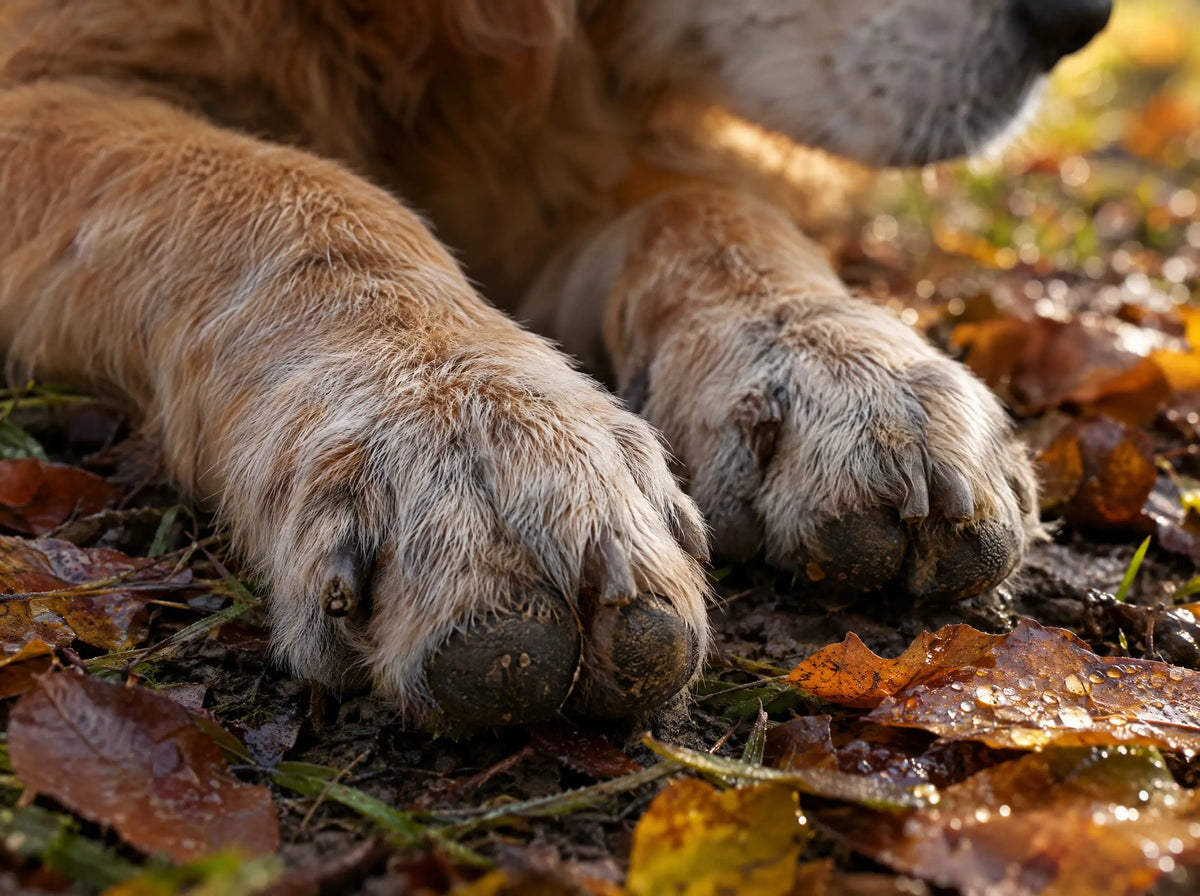
You've probably noticed it. Summer's over, the hot sidewalks are gone, the long walks have wound down, and somehow your dog's paw pads look worse than they did all summer. Drier. Rougher around the edges. Maybe even a small crack that wasn't there a few weeks ago.
It's confusing. The hard part is supposed to be behind you. The pavement's cooled off. So why now?
Here's the simple answer: what you're seeing didn't start this week. It's summer catching up.
The damage was there all summer, you just couldn't see it
Paw pads are tough. They're built to handle a lot, which is exactly why summer damage tends to stay hidden until later.
All season long, the pads take a quiet beating. Hot pavement, gritty trails, sand at the beach, chlorine from the pool, salt water, even lawn chemicals all wear them down a little at a time. None of it usually causes an obvious problem on the day it happens. The pads just keep doing their job. But underneath, that tough outer layer is slowly wearing thin.
By the time summer ends, the pads are far more worn than they look. They're just waiting for something to tip them over the edge. And fall is happy to oblige.
Then fall dries everything out
Once the weather turns, the air itself changes, and it's hard on pads that are already worn.
As the mornings cool and the humidity drops, the air starts pulling moisture out of your dog's skin. A healthy pad can handle that just fine. A pad that spent all summer wearing thin can't, so it goes dry, tight, and rough surprisingly fast. The same crisp fall air that a resilient pad would shrug off leaves a summer-worn pad cracking at the edges.
This is why the timing feels so backwards. It isn't that fall is harsher than summer. It's that your dog's pads walked into fall already weakened, and the drier air finishes what summer started.
The heating makes it worse, from the inside
Here's the part almost everyone misses. Once you turn the heating on, the air inside your home gets dry too.
Now your dog's pads are drying out from both sides: cool, dry air outdoors and warm, dry air at home. Dogs that love to stretch out right next to a radiator, a heat vent, or the fireplace feel it the most, because that direct heat pulls even more moisture out of already-thirsty skin.
If your dog's pads seem to get worse in the evenings or overnight, this is usually why. A humidifier and a cozy spot away from direct heat make a real difference through the colder months.
The wet-then-dry problem
Fall has one more trick. Wet mornings, dewy grass, and damp leaves soak the pads, then your dog comes inside to dry indoor heat.
That back-and-forth is harder on paws than staying wet or staying dry would be. The pad softens when it's wet and hardens as it dries, over and over, and that constant cycle is what turns a merely rough pad into a cracked one — especially in the thin, delicate skin between the toes. Drying the paws off after every damp walk is a small habit that prevents a lot of this.
Some dogs show it first
If your dog is older, or a bigger breed like a Labrador, Golden Retriever, or German Shepherd, you'll probably notice all of this sooner and more strongly. Their pads are already more prone to getting thick and dry, so they reach the visible, rough, cracked stage first.
If that's your dog, and their pads look rough this fall, this is almost always why. It's not something you did wrong. It's just the season doing what it does to skin that was already worn.
It often shows up on the nose too
While you're checking the paws, take a look at your dog's nose. The same dry fall air and indoor heating that rough up the pads can leave the nose dry, crusty, or flaky at the same time, for exactly the same reasons.
It's common enough that a good repair balm should work on both the paws and the nose, so you're not juggling two separate products for what is really the same problem showing up in two places.
What to look for
You don't need to diagnose anything. Just turn each paw over and run your thumb across the pads and around the edges of the toes. You're feeling for:
- Dry, rough, or flaky patches where the pad used to be smooth
- Pads that feel hard and stiff instead of a little springy
- Small cracks or splits, especially at the edges and between the toes
- Any spot that makes your dog flinch, or that they keep licking afterward
Most of the time it's simple dryness you can turn around at home. But some signs mean it's worth getting a professional set of eyes on it.
When to call your vet
Home care handles the everyday fall dryness. Book a vet visit, though, if you notice any of these:
- A pad that's cracked and bleeding, or looks swollen, feels warm, or smells off. That can mean an infection, which needs proper treatment.
- Pads that are severely thickened, hard, or crusty, well beyond ordinary dryness. This can be a sign of hyperkeratosis or, occasionally, an underlying health issue worth ruling out.
- Constant licking or chewing, brown saliva staining on the fur, or a musty smell. These can point to allergies or a yeast problem rather than plain dryness.
- Dry, crusty changes showing up in several places at once — paws, nose, and elsewhere — which is worth having a vet look at properly.
- No improvement after a few weeks of consistent care. If you've been doing everything right and the pads aren't bouncing back, it's time to check in.
None of this is meant to alarm you. The vast majority of "why are my dog's paws suddenly rough?" cases in fall are simple seasonal dryness. But you know your dog, and if something feels off, a quick visit is always worth it.
What actually helps
Here's where a lot of people lose the fall. The usual go-to is petroleum jelly or coconut oil, but they mostly sit on top of the pad without fixing the worn skin underneath, and your dog just licks them off anyway. The pad looks shiny for an hour, then it's rough again by evening.
A worn pad needs more than a coating. The tough outer layer has thinned out, and the skin underneath needs to actually rebuild. So you want something that soaks in and helps it recover, not just something that sits on the surface.
That's why we build our repair balm around sea buckthorn oil. It's rich in omega-7, a nourishing fatty acid that absorbs into the deeper layer of the pad and helps the skin repair itself from within, instead of just glossing over the top. On a rough, worn pad, that's the difference between a quick shine and skin that's genuinely tougher a few weeks later — right before winter puts it to the test.
A few simple things make it work far better:
- Soak the pads in warm water for a few minutes first. It softens hard, dry pads so the balm can actually sink in. Skipping this is the number one reason a balm seems to "do nothing."
- Do it daily, and give it time. Worn skin rebuilds over a few weeks, not overnight. Consistency beats intensity here.
- Use something that's safe if it's licked. Dogs lick their paws, so whatever you use should be made for dogs and safe if licked.
Keep checking the pads by hand each week. Once you know what that early roughness feels like, you'll catch it next time before it ever turns into a crack.

The good news
If your dog's paws look worse now that summer's over, you're not imagining it, and it's not a new injury. It's old summer wear finally showing up in dry fall air. And that's actually the best possible time to fix it, because right now, while the weather's still mild, it's easy.
Wait until deep winter and you're dealing with cracked pads plus cold, ice, and road salt all at once. Handle it now and your dog heads into the cold months with pads that can take it.
If your dog's pads are already dry, rough, or cracked, that's exactly what our Sea Buckthorn Healing Balm is made for: deep, penetrating repair for worn and damaged pads and noses, and safe if your dog licks it. (Already thinking about winter? It also comes paired with our Winter Shield in the Winter Protection & Healing Set — repair now, protection for the cold ahead.)
Turn the paw over, feel what summer left behind, and start now, while it's still the easy season to do it.