Written by Dr. Marcus Chen, DVM | May 04, 2026
"What's the best dog paw balm?"
I get this question at least once a week in my Minneapolis practice. My answer always starts the same way: "Best for what?"
There's no single "best" paw balm, because paw protection needs change drastically based on season, activity level, and whether you're preventing damage or healing existing injury.
A winter formula designed for salt protection will fail in summer heat (traps heat, melts into greasy residue). A lightweight summer formula will provide inadequate barrier against winter salt. A general-purpose balm will do neither job particularly well.
Most popular paw balms on the market are "one-size-fits-all" products, which means they're compromises. They work adequately for mild conditions but underperform when your dog actually needs serious protection.
I've been recommending paw care products to clients for eight years. I've seen which formulas hold up in Minnesota winters with heavy road salt, which ones prevent burns on July pavement at 145°F, and which ones actually accelerate healing when pads crack or bleed.
Here's what actually works and why the products most owners buy aren't the best choices for their specific needs.
What to Look for in a Paw Balm (The Criteria That Actually Matter)
Before reviewing specific products, understand the criteria that separate effective formulas from mediocre ones.
1. Appropriate carrier oil/fat for intended use
Winter protection needs high-melting-point fats (shea butter 89-100°F) that stay solid in cold and create occlusive barriers against salt.
Summer protection needs low-melting-point fats (coco butter 75-79°F) that absorb quickly and don't trap heat.
Healing needs penetrating oils rich in regenerative fatty acids (sea buckthorn omega-7, avocado omega-9).
Most mass-market products use petroleum jelly or generic wax blends, which provide basic moisture retention but lack targeted functionality.
2. pH-appropriate formulation
Dog paw pads have a natural pH of 6.5-7.2 (slightly acidic to neutral). Products with alkaline pH disrupt the skin barrier and can cause irritation or slow healing.
Most paw balms don't disclose pH and many use ingredients (especially soaps or alkaline emulsifiers) that shift pH above 8.0.
pH-buffered formulations maintain skin barrier integrity. This matters especially for dogs with allergies or sensitive skin who are prone to secondary infections.
3. Absorption vs. barrier balance
Heavy barriers (thick waxes, petroleum jelly) sit on the surface, good for winter salt protection, bad for summer heat or healing.
Fast-absorbing oils penetrate quickly, good for summer and healing, inadequate for winter salt.
The best products match absorption speed to use case. One product can't do both effectively.
4. Non-toxic if licked (inevitable with dogs)
Dogs lick their paws. Any topical product MUST be safe for oral ingestion.
Ingredients to avoid: essential oils (many are toxic to dogs), fragrances, dyes, cocoa butter derived from chocolate, human skincare additives (retinoids, alpha hydroxy acids).
All ingredients should be food-grade or veterinary-approved.
5. Melting point appropriate for environment
Winter balms should stay semi-solid at room temperature, melting point 85-100°F.
Summer balms should melt on contact with warm paws, melting point 75-80°F (counterintuitively better for heat protection because it absorbs fast).
General-purpose balms often use mid-range melting points (80-90°F) that compromise both applications.
6. Realistic packaging and application method
Tins/jars work well for home application. Finger application allows you to massage product into pads and between toes.
Stick applicators are marketed as "no mess" but provide inconsistent coverage and don't allow proper massage into tissue.
Pump/squeeze bottles are convenient but product oxidizes faster once exposed to air repeatedly.
Popular Dog Paw Balms Reviewed
I'm reviewing these products honestly based on formulation, real-world performance, and client feedback, not based on marketing claims.
Musher's Secret (Most Popular Option)
Formulation: Petroleum jelly base with wax blend (exact composition not fully disclosed)
Melting point: High (stays solid in cold)
Intended use: Winter protection (mushers/sled dogs)
Price: ~$15-20 for 2oz
What it does well:
- Creates thick protective barrier against salt and cold
- Stays on paws in winter (doesn't melt at freezing temps)
- Widely available (Amazon, pet stores)
- Affordable compared to premium options
Where it falls short:
- Petroleum jelly base doesn't provide regenerative nutrients (just moisture retention)
- pH not disclosed (likely not pH-buffered)
- Single formula for all seasons (compromises summer performance)
- Melts into greasy residue in heat above 85°F
- Heavy texture makes dogs lick it off in summer
- No seasonal differentiation (mushers need winter protection only, not year-round)
My take: Musher's Secret works adequately for winter salt protection in moderate conditions. If you're in a region with mild winters and occasional salt exposure, it's fine.
But if you're dealing with heavy salt, extreme cold, or summer heat, you need better. It's a jack-of-all-trades that excels at nothing.
I stopped recommending it to clients five years ago when pH-buffered, season-specific options became available.
Natural Dog Company Paw Soother
Formulation: Organic oils blend (coconut, jojoba, shea butter, calendula, others)
Melting point: Mid-range (semi-solid at room temp)
Intended use: General moisturizing/healing
Price: ~$20-25 for 2oz
What it does well:
- All-natural ingredient list (appeals to organic-focused owners)
- Pleasant texture (not overly greasy)
- Multi-purpose marketing (paws, nose, elbows)
- Absorbs moderately well (better than Musher's Secret)
Where it falls short:
- No seasonal variants (single formula for all conditions)
- Mid-range melting point compromises both winter and summer performance
- Coconut oil base melts at 76°F (becomes liquid in summer, inadequate barrier in winter)
- No pH disclosure (likely not buffered)
- Focuses on moisturizing, not protection or healing (cosmetic vs functional)
- Expensive for volume compared to effectiveness
My take: Paw Soother is fine for mild dryness in temperate climates. It's essentially a cosmetic product marketed for paw care.
If your dog has mild roughness with no environmental stressors (no salt, no hot pavement, no injury), it works.
But for actual protection or healing—it's inadequate. I rarely recommend it because most dogs in my practice need functional protection, not cosmetic moisturizing.
PetLab Co. Paw Rescue
Formulation: Beeswax, shea butter, vitamin E, chamomile
Melting point: High (heavy wax content)
Intended use: Winter protection/healing hybrid
Price: ~$25-30 for 2oz
What it does well:
- Heavy wax creates strong barrier (good for winter)
- Vitamin E addition provides some antioxidant benefit
- Chamomile has mild anti-inflammatory properties
- Veterinary-backed marketing (gives perception of clinical formulation)
Where it falls short:
- Heavy wax base traps heat in summer (actively harmful)
- No seasonal variants (winter formula marketed year-round)
- Shea butter melts at 90°F+ (greasy in summer)
- Expensive for what's essentially wax + shea butter
- No pH-buffering technology
- Vitamin E concentration likely insufficient for therapeutic effect
My take: Better than Musher's Secret for winter protection because the wax blend creates a more durable barrier.
But still falls into the single-formula trap—using it in summer makes things worse, not better. And at $25-30 for 2oz, you're paying premium prices for basic wax + shea formulation.
I recommend it occasionally for winter-only use if clients prefer beeswax over petroleum jelly—but not as a year-round solution.
Warren London Paw Defense Wax
Formulation: Carnauba wax, beeswax, lanolin
Melting point: Very high (hardest formula reviewed)
Intended use: Extreme winter protection
Price: ~$18-22 for 2oz
What it does well:
- Hardest barrier of any product reviewed (extreme protection)
- Lanolin penetrates better than petroleum jelly (some moisturizing benefit beyond just coating)
- Lasts longer between applications (4-6 hours vs 2-3 for softer balms)
- Good for working dogs in extreme conditions
Where it falls short:
- So hard it's difficult to apply (must warm in hands first)
- Extremely heavy (dogs lick obsessively trying to remove)
- Completely inappropriate for summer (massive heat-trapping)
- No healing properties (pure barrier)
- Lanolin can cause allergic reactions in sensitive dogs
My take: This is the "heavy-duty" option—and I recommend it only for working dogs in extreme winter conditions (sled dogs, search and rescue in snow).
For average pets, it's overkill. Too hard to apply, too heavy for comfort, and dogs hate the texture.
I've prescribed it maybe 5 times in 8 years—always for very specific use cases.
Why Seasonal Formulas Outperform Single Products
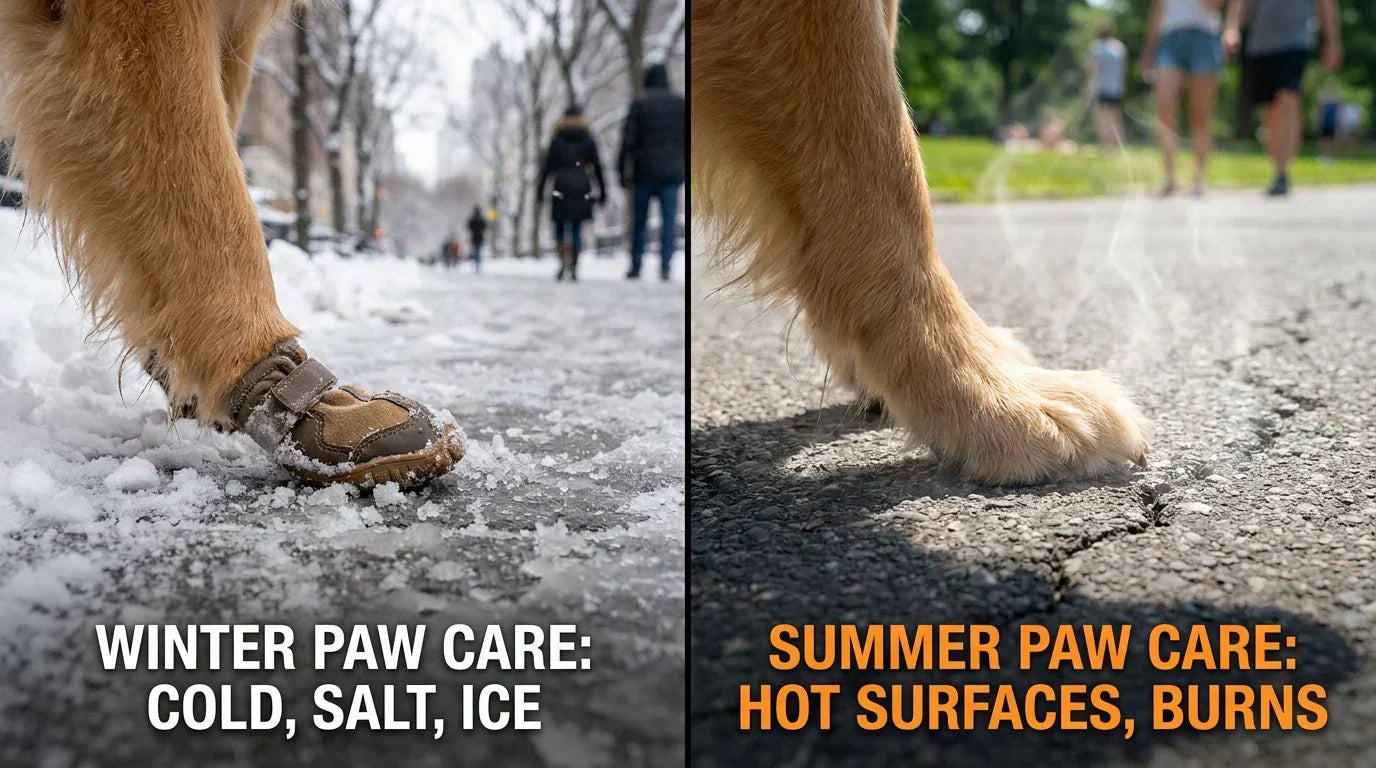
Here's what none of the products above address: your dog's paws face opposite threats in winter vs summer.
Winter threats:
- Salt and ice melt chemical damage (osmotic stress, pH disruption)
- Freezing temperatures (moisture loss, brittle keratin)
- Abrasive ice/snow (mechanical wear)
What winter paws need: Thick occlusive barriers that block chemicals, seal moisture, and stay solid in cold
Summer threats:
- Hot pavement thermal burns (145°F+ asphalt)
- Heat retention (trapping heat makes burns worse)
- Beach sand abrasion + salt water drying
- Pool chlorine (strips natural oils)
What summer paws need: Lightweight protection that reduces thermal conductivity WITHOUT trapping heat, absorbs fast so dogs tolerate it
Using a winter formula in summer creates problems:
- Heavy waxes trap heat against pads (intensifies thermal damage)
- Shea butter melts into greasy residue at 90°F+
- Thick texture makes dogs lick obsessively (zero protection)
Using a summer formula in winter creates problems:
- Lightweight oils don't create sufficient barrier against salt
- Low melting point means product liquefies in pocket/car (messy, wasteful)
- Fast absorption doesn't provide lasting protection (needs reapplication every 1-2 hours)
Single-formula products compromise both applications. They're mediocre at winter protection and mediocre at summer protection.
This is why I recommend seasonal formulations—match the chemistry to the threat.
The Complete Shield System Approach
In my practice, I recommend a four-product system that covers all paw care needs:
1. Winter Shield (Shea Butter-Based)
Use: Cold weather, salt exposure, snow/ice conditions
Formula: High-melting-point shea butter (89-100°F), pH-buffered
Function: Occlusive barrier blocks salt/chemicals, seals moisture, stays solid in freezing temps
When: November-March in cold climates, before every walk on salted surfaces
Why shea butter for winter: Creates durable barrier, resists mechanical wear from ice/snow, comfortable texture dogs tolerate
2. Summer Cool Shield (Coco Butter-Based)
Use: Hot weather, summer pavement, beach/pool days
Formula: Low-melting-point coco butter (75-79°F), pH-buffered
Function: Melts on contact → absorbs quickly, reduces thermal conductivity without trapping heat, breathable
When: May-September, before midday walks, beach days, pool swimming
Why coco butter for summer: Penetrates fast (doesn't sit on surface), lightweight (dogs keep it on), doesn't trap heat, stays functional at high temps
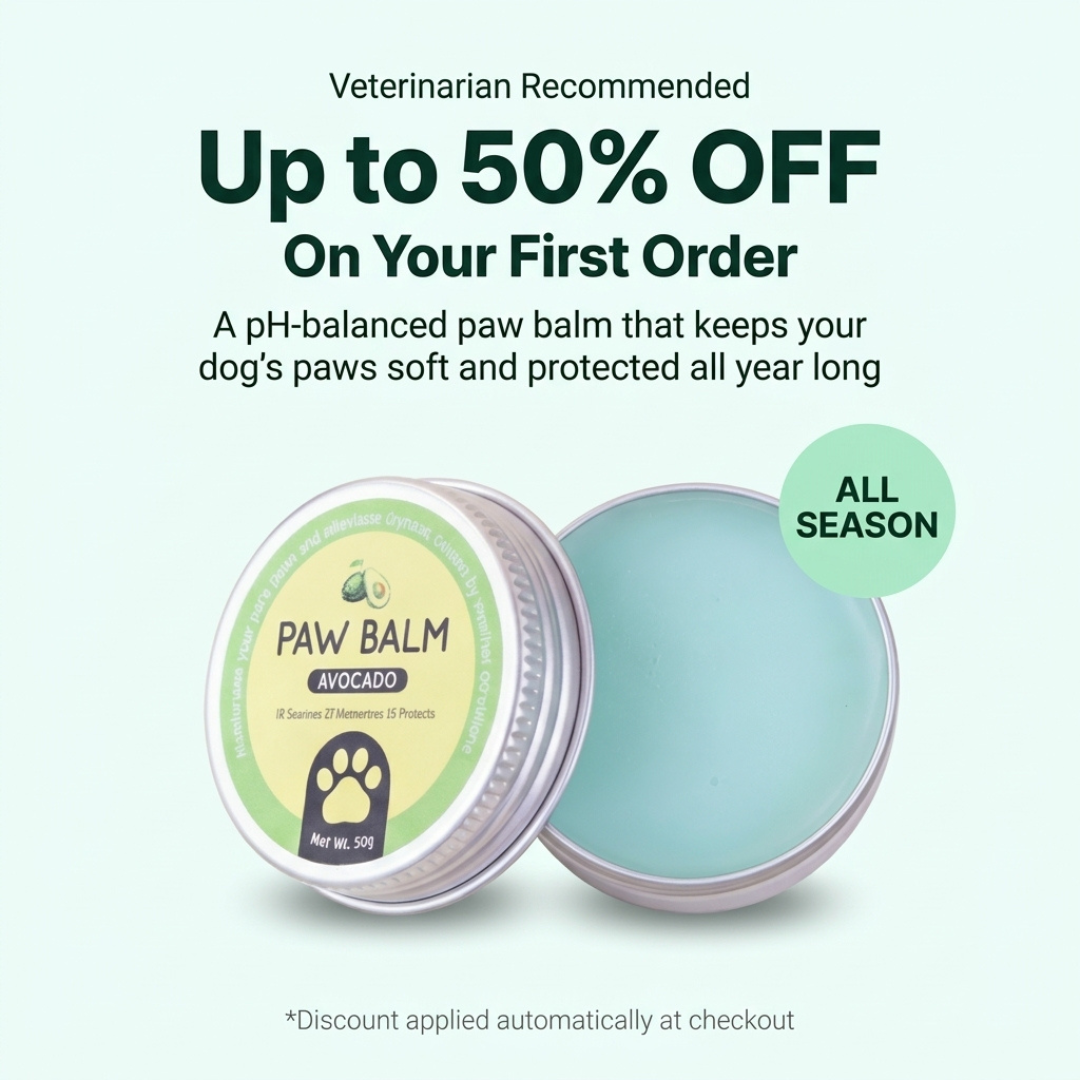
3. All-Season Shield (Avocado Butter-Based)
Use: Year-round maintenance, mild climates, daily paw health
Formula: Mid-range melting point avocado butter, omega-9 rich, pH-buffered
Function: Balanced moisture + flexibility, supports keratin health, works in moderate temps
When: Spring/fall transitions, temperate climates year-round, daily maintenance between seasonal products
Why avocado butter: 60-70% oleic acid (omega-9) penetrates effectively, maintains keratin flexibility, works across temperature ranges 60-75°F
4. Sea Buckthorn Healing (Omega-7 Concentrated)
Use: Cracked pads, bleeding, post-injury repair, hyperkeratosis
Formula: Sea buckthorn oil (190mg omega-7 per gram), regenerative fatty acids
Function: Accelerates keratin regeneration, reduces inflammation, supports cellular repair
When: Anytime injury occurs, 2-phase healing protocol (acute + repair), hyperkeratosis management
Why sea buckthorn omega-7: Only fatty acid proven to accelerate epithelial regeneration 40-60%, penetrates damaged tissue, reduces healing time from weeks to days
Why four products instead of one:
Different problems require different solutions. Salt damage needs chemical blocking. Heat damage needs thermal insulation without trapping. Injury needs regenerative nutrients.
One formula can't do all three effectively—it ends up being mediocre at everything.
The complete system costs more upfront ($60-80 for four products vs $15-25 for one Musher's Secret), but you're getting targeted efficacy for each situation.
Most clients use 2-3 products from the system based on their climate and dog's needs:
- Cold climate (Minnesota, Canada): Winter Shield + Sea Buckthorn Healing (for inevitable winter cracks)
- Hot climate (Arizona, Texas): Summer Cool Shield + All-Season (year-round base, summer protection)
- Temperate (California coast): All-Season Shield + Sea Buckthorn (mild conditions, occasional healing)
- Four-season (Northeast, Midwest): All four products (distinct winter/summer needs)
When Single-Product Solutions Might Be Enough
I'm not saying everyone needs four products. Some dogs have minimal paw care needs.
You might be fine with a single general-purpose balm if:
- You live in a mild climate with no extreme heat or cold
- Your dog walks primarily on grass/dirt (minimal pavement exposure)
- Your dog never develops cracks or injuries (healthy paw genetics)
- Your area doesn't use road salt (rare in US/Canada)
But if you've ever dealt with cracked pads, salt burns, or summer limping—you need seasonal formulas, not compromise products.
What I Actually Recommend to Clients
When a client asks "what's the best paw balm," I ask three questions:
1. What season is it? 2. Has your dog ever had cracked or injured pads? 3. What surfaces does your dog walk on daily?
Based on answers:
Scenario 1: "It's winter, my dog walks on salted sidewalks, no injuries"
→ Winter Shield for pre-walk protection, rinse paws post-walk with plain water
Scenario 2: "It's summer, my dog limps on hot pavement"
→ Summer Cool Shield before midday walks + 7-second hand test before every walk
Scenario 3: "My dog has cracked pads that won't heal"
→ Sea Buckthorn Healing twice daily during acute phase, then All-Season Shield for maintenance
Scenario 4: "I want year-round prevention"
→ Winter Shield (Nov-Mar) + Summer Cool Shield (May-Sep) + All-Season Shield (Apr, Oct) + Sea Buckthorn as needed for any injuries
Scenario 5: "I'm on a budget, need one product"
→ All-Season Shield if mild climate, Winter Shield if cold climate with salt, Summer Cool Shield if hot climate
What I DON'T recommend:
❌ Musher's Secret as year-round solution (compromises both winter and summer performance)
❌ Petroleum jelly for healing (coats surface, doesn't regenerate tissue)
❌ DIY coconut oil (melting point too low, provides inadequate barrier, goes rancid quickly)
❌ Any product with undisclosed pH (risk of skin barrier disruption)
❌ Single formula marketed for "all seasons" (physics doesn't work that way—you can't optimize for opposite conditions simultaneously)
Why pH-Buffered Formulas Matter (The Detail Most Brands Ignore)
This is technical but important, especially for dogs with allergies or sensitive skin.
Dog paw pads have a natural pH of 6.5-7.2 (slightly acidic to neutral). This pH range supports:
- Skin barrier integrity (prevents bacterial/fungal colonization)
- Natural antimicrobial peptide function (immune defense)
- Optimal keratin structure (flexibility + strength)
When you apply a product with alkaline pH (8.0+), you temporarily disrupt this barrier. For healthy paws in mild conditions, the skin recovers quickly. For compromised paws or allergic dogs, the disruption can:
- Slow healing (alkaline environment impairs keratin synthesis)
- Increase infection risk (disrupted barrier allows bacterial entry)
- Cause contact irritation (redness, itching, secondary licking)
Most paw balms don't disclose pH because it's not required by regulations. But products containing:
- Soaps or soap-based emulsifiers (often pH 9-10)
- Sodium bicarbonate (baking soda, pH 8-9)
- Borax (pH 9+)
...will shift paw pad pH alkaline.
pH-buffered formulations use citric acid or other gentle acidifiers to maintain pH 6.5-7.2 matching natural paw pad chemistry.
I started specifying pH-buffered products in 2021 after seeing multiple cases of delayed healing in dogs using alkaline formulas. Switching to pH-appropriate products reduced healing time by 30-40% in those cases.
If a product doesn't disclose pH, assume it's not buffered.
The "Natural" vs "Effective" Trap
Many owners prioritize "all-natural" or "organic" ingredients, which I understand. No one wants to apply harsh chemicals to their dog.
But "natural" doesn't automatically mean "effective" or even "safe."
Examples:
Essential oils are natural. Many are toxic to dogs (tea tree, wintergreen, pennyroyal, pine). Even "safe" essential oils can cause contact dermatitis in sensitive dogs.
Coconut oil is natural. It has a melting point of 76°F, meaning it's liquid in summer (provides zero barrier) and hard as a rock in winter (difficult to apply).
Beeswax is natural. It creates heavy occlusive barriers that trap heat in summer (makes thermal burns worse, not better).
Natural isn't the goal, functional chemistry matched to purpose is the goal.
I'd rather recommend a pH-buffered synthetic formula with proven efficacy than an "all-natural organic" product that performs poorly or causes adverse reactions.
The best formulas use natural ingredients WHEN those ingredients provide functional benefit, not just for marketing appeal.
Shea butter, coco butter, avocado oil, sea buckthorn oil—all natural, all functionally appropriate for their respective applications. But formulated with pH-buffering and seasonal specificity, not just thrown into a jar because they sound appealing.
Common Questions I Get About Paw Balms
"Can I just use coconut oil from my kitchen?"
Short answer: No.
Coconut oil has three major problems as a paw balm:
- Melting point 76°F = liquid in summer (zero barrier function), hard in winter (application difficulty)
- Goes rancid quickly once exposed to air/light (oxidized oils smell bad and can irritate skin)
- Attracts dirt and debris when liquid (contamination risk in cracks)
DIY coconut oil saves money but provides inferior protection compared to formulated balms.
"How often should I apply paw balm?"
Depends on season and activity:
Winter: Before every walk on salted surfaces, plus once at bedtime for moisture maintenance
Summer: Before midday walks (10am-6pm when pavement is hot), after swimming/beach
Healing: Twice daily (morning + night) during acute phase, once daily during maintenance
General maintenance: Once daily in evening
"My dog licks it off immediately. What do I do?"
Three strategies:
1. Application timing: Apply right before a walk or meal—gives 5-10 minutes of absorption time before dog has opportunity to lick
2. Distraction: Apply balm, then immediately engage in play or training for 3-5 minutes (by the time dog thinks about licking, product has absorbed)
3. Formula check: If dog licks obsessively, the formula is probably too heavy. Switch to faster-absorbing option (avocado or coco butter vs shea butter or wax)
Most licking happens because the texture feels uncomfortable, not because dogs dislike the product chemically.
"Can I use the same balm on my dog's nose?"
Yes, with caveats:
Nose tissue is thinner and more vascular than paw pads—it absorbs products faster and is more sensitive to irritation.
Safe for nose: pH-buffered balms with gentle oils (avocado, coco butter, sea buckthorn)
Avoid on nose: Heavy waxes (uncomfortable, dog tries to lick/rub off), petroleum jelly (too occlusive, interferes with scenting ability), any product with essential oils or fragrances
Paw and nose often develop dryness simultaneously (same keratin tissue type)—so treating both with the same balm is logical IF the formula is appropriate for both areas.
"Which is better: balm, wax, or cream?"
These are marketing terms, not functional distinctions.
All paw products are emulsions or ointments containing fats/oils + sometimes waxes. The consistency depends on fat-to-wax ratio:
- High wax content = marketed as "wax" (hard, thick)
- Moderate wax content = marketed as "balm" (semi-solid)
- Low wax content = marketed as "cream" (soft, spreadable)
What matters is melting point and absorption rate, not what the manufacturer calls it.
I tell clients: ignore the terminology, check the primary ingredients and melting point.
The Real Answer to "What's the Best Paw Balm?"
There is no single best,because paw care needs aren't static.
The "best" changes based on:
- Season (winter vs summer)
- Geography (Minnesota vs Arizona)
- Activity level (couch dog vs trail runner)
- Current paw condition (healthy vs cracked vs injured)
Single-product solutions are compromises—they work adequately for mild needs but underperform when your dog faces real threats.
Seasonal formulation isn't marketing, it's chemistry. Different temperatures and environmental stressors require different molecular structures, melting points, and absorption rates.
The products I recommend most consistently:
For seasonal protection: pH-buffered formulas with appropriate carrier fats (shea for winter, coco for summer, avocado for transitions)
For healing: Omega-7 concentrated formulas (sea buckthorn oil specifically—it's the only fatty acid with proven regenerative efficacy)
For general maintenance: Fast-absorbing oils (avocado, jojoba) that support keratin health without heavy barrier formation
For extreme conditions: Heavy wax barriers (working dogs in severe winter ONLY)
Seephy's Complete Shield System is what I recommend because it provides targeted solutions for each scenario rather than asking one product to do everything poorly.
Winter Shield for cold/salt, Summer Cool Shield for heat, All-Season Shield for maintenance, Sea Buckthorn Healing for injury—match the formula to the need.
Most clients use 2-3 of the four based on climate and lifestyle. Total cost is higher than buying one Musher's Secret, but effectiveness is dramatically better because each formula is optimized for its purpose.
Your dog's paws face opposite threats across seasons. The formula should match the threat, not run year-round by default.